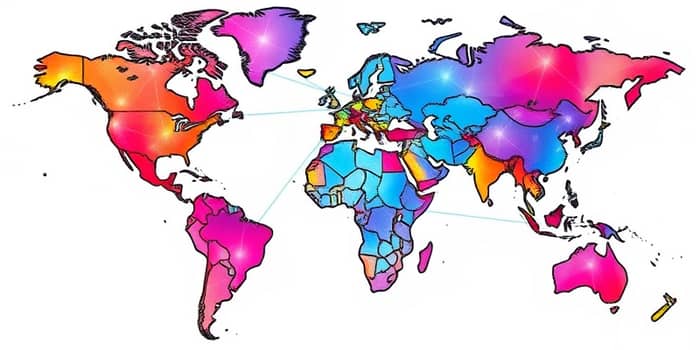
The world economy is undergoing a profound transformation, moving beyond traditional trade wars into an era of strategic realignments.
This shift is fueled by slowing but resilient global growth, where policy decisions reshape trade and investment flows.
Beneath modest economic numbers, technology- and security-driven industrial policies are creating new alliances and barriers.
Understanding this landscape is crucial for navigating the future of commerce and prosperity.
Global growth is projected to slow, yet it remains stable in the face of mounting challenges.
According to UNCTAD, world output is expected to decelerate to about 2.7% in 2026.
This is below the pre pandemic average of 3.2%, indicating subdued expansion.
Domestic demand and easing inflation provide support, but investment remains weak.
Structural headwinds, such as high debt and geopolitical risks, persist across regions.
The divergence in growth rates highlights increasing economic fragmentation.
Regional forecasts for 2026 illustrate stark differences in economic performance.
Inflation and interest rates are easing, but policy uncertainty lingers.
Developed market core inflation is trending toward central bank targets by 2026.
U.S. core PCE inflation is estimated around 2.3%, excluding tariff effects.
Policy rate cuts in the U.S. and other regions are likely, providing some relief.
However, these macro trends set the stage for deeper structural shifts in trade.
Trade conflicts have evolved from episodic battles to enduring barriers.
Deloitte notes that in 2025, the U.S. raised significant barriers to trade.
This disrupted supply chains and created financial volatility worldwide.
By 2026, new trade deals restored predictability but at higher costs.
Restrictive U.S. policies pushed non U.S. countries closer together, fostering new alliances.
Global trade growth is projected to slow in 2026 as temporary drivers fade.
Front loading of shipments ahead of tariffs boosted 2025 trade, but this effect is waning.
Persistent barriers and policy uncertainty continue to dampen trade prospects.
This shift signifies that trade war dynamics are now part of a slow structural decoupling.
Countries are re wiring their economic relationships based on security and technology.
The focus is on building resilience rather than purely on cost efficiency.
New alignments are forming around regional hubs and strategic partnerships.
These blocs are driven by policy decisions and the need for supply chain security.
U.S. centered realignments include re shoring and friend shoring initiatives.
Selective decoupling from China is a key strategy, as seen in bilateral deals.
The USMCA hub in North America is crucial, with a review scheduled for July 2026.
Mexico expects investment rebounds in 2026, supporting nearshoring and manufacturing.
Europe faces constrained repositioning between U.S. and Chinese pressures.
The eurozone struggles with U.S. tariffs and China's competitive export surge.
China's current account surplus is projected to rise to almost 1% of global GDP.
This creates pressure on economies like Germany that compete with China.
Europe's response includes a 500 billion euro multi year infrastructure package.
Industrial and defense policy is becoming central to European economic strategy.
South South and non U.S. centric deals are proliferating as countries seek alternatives.
Restrictive U.S. trade policy has pushed other nations to forge closer ties.
Numerous trade deals among non U.S. countries are emerging, such as in Latin America.
Regional compacts in Asia and Africa aim for resilience without reliance on major powers.
For businesses and policymakers, adapting to these changes is essential.
Building resilient supply chains requires diversifying sources and partnerships.
Investing in technology and innovation can help mitigate trade barriers.
Engaging with regional blocs offers opportunities for growth and collaboration.
Monitoring policy developments, such as tariff reviews and trade deals, is critical.
This new era demands a proactive approach to economic strategy.
By embracing change, stakeholders can turn challenges into opportunities for innovation.
The future belongs to those who can adapt to evolving alignments and thrive.
References