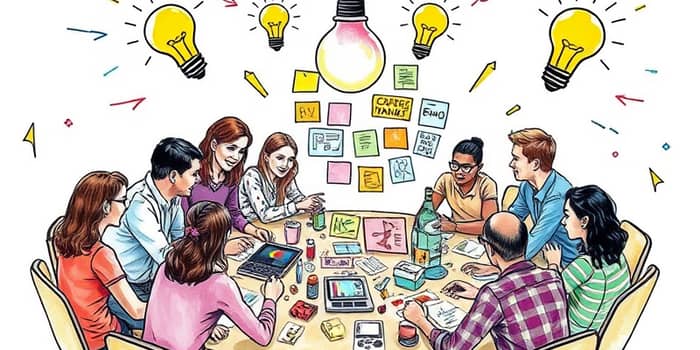
In an age of rapid technological advances and shifting consumer expectations, businesses face unprecedented challenges. How can organizations anticipate unspoken needs, respond to complex dynamics, and stay ahead? The answer lies not in cutting-edge code or massive budgets alone, but in embracing a human-centered and iterative methodology that turns real problems into meaningful opportunities. By placing empathy, experimentation, and collaboration at the core of innovation, teams can unlock transformative solutions that resonate deeply with both customers and stakeholders.
This article offers a comprehensive guide to mastering Business Design Thinking. We explore its core principles, leading models, detailed phases, transformative benefits, inspiring case studies, and hard-earned lessons from failure. Along the way, you will discover practical steps and forward-looking trends to guide your own journey toward sustainable innovation.
At its heart, Design Thinking prioritizes deep human understanding over assumptions. The journey begins by stepping into users’ shoes through observation, empathetic interviews, and immersion in context. This foundation ensures that subsequent ideas and prototypes remain grounded in genuine needs rather than internal biases or outdated metrics.
The process revolves around four key pillars:
By weaving these elements together, organizations foster cultures where failure is reframed as learning, and where every team member feels empowered to contribute ideas.
Consider the example of a healthcare provider that transformed its patient intake process. By observing staff and patients in real clinics, the team uncovered hidden bottlenecks and emotional stressors. With empathy as their guide, they co-created a digital check-in system that not only streamlined operations but also provided personalized reassurance messages to anxious visitors, boosting overall satisfaction scores by 30% within months.
Design Thinking adapts to various contexts through frameworks that balance structure with flexibility. Three widely recognized models include:
The Stanford model’s step-by-step nature helps teams systematically advance while remaining open to looping back when new insights emerge. IDEO’s approach encourages early experimentation followed by rigorous refinement, injecting creative confidence into every stage. The Double Diamond framework alternates between broad exploration and focused problem solving, preventing premature conclusions and ensuring depth of insight.
Teams often revisit earlier phases as new data emerges. This powerful non-linear iterative learning process ensures that final outcomes remain aligned with evolving user needs and market realities.
Organizations adopting Design Thinking report remarkable improvements. They achieve higher customer satisfaction and loyalty, translating into repeat business and advocacy. Operational efficiency improves as teams embrace a streamlined prototyping cycle that reduces development time and costs. Cross-functional alignment becomes stronger, as silos dissolve when diverse stakeholders collaborate from the outset. Finally, a culture of creative confidence emerges, empowering employees to propose bold ideas and take calculated risks.
For example, a retail chain revamped its online and in-store experience by creating an “empathy lab” where developers and frontline employees co-designed new checkout prototypes. The result was a 25% increase in conversion rates and a 15% decrease in cart abandonment within one quarter.
Across industries, Design Thinking has sparked breakthrough innovations:
P&G Swiffer Mop: Observations of messy cleaning methods led to a lightweight, disposable cloth system, generating over $100 million in its first year and redefining household cleaning.
GE MRI Adventure Series: Empathizing with children’s fears, designers transformed scans into interactive stories. Patient cooperation soared, reducing the need for sedation.
Airbnb: By focusing on high-quality photography and two-way reviews, founders built trust in a previously untested home-sharing market, fueling explosive growth.
Netflix: Moving from DVD rentals to a subscription streaming model solved pain points of late fees and limited availability, changing the entertainment landscape forever.
Yet, failures provide sobering insights. J.C. Penney modernized its pricing without customer input, eliminating beloved discounts. Sales plummeted by over 20%, forcing a strategic retreat and leadership shakeup. This cautionary tale highlights the perils of bypassing deep user research and validation.
Additional successes span diverse sectors: IBM embedded the approach across global teams to accelerate digital transformation, Nike used athlete feedback to refine product designs, and a social enterprise in Ghana deployed user-centered sanitation solutions that improved health outcomes dramatically.
Design Thinking’s roots trace back to the mid-20th century, when industrial designers began formalizing creative processes. IDEO’s thought leaders and Stanford’s d.school have since popularized the methodology, integrating it into MBA programs and corporate training worldwide. Today, public sector entities like the UK government’s Service Design Standard and the US Army Field Manual incorporate design principles to enhance citizen services and operational readiness.
Looking forward, emerging trends promise to propel Design Thinking into new frontiers:
By marrying technological advances with human insight, organizations can unlock unprecedented levels of innovation and resilience.
Getting started requires both mindset and method. Follow these steps to build momentum:
This immersive hands-on experiential design approach fosters a culture of curiosity and resilience, setting the stage for sustained innovation.
Embracing Business Design Thinking is more than adopting a process; it’s a transformative shift in how organizations perceive challenges and opportunities. By entwining empathy, creativity, and rigorous experimentation, teams can craft solutions that not only solve immediate needs but also anticipate future desires, driving lasting value for both users and enterprises. Start today, and empower your organization to innovate with purpose, agility, and heart.
References