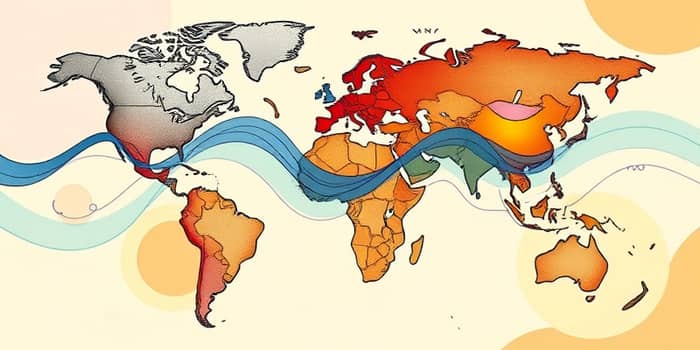
The global population landscape is transforming in ways that redefine our economic and social futures.
Beyond the well-known aging of societies, we face inverted age structures and a looming youth scarcity across many regions.
This shift from pyramids to obelisks signals a profound change that demands innovative responses and strategic foresight.
Understanding these dynamics is crucial for businesses, policymakers, and individuals alike.
Demographic changes are not uniform; they occur in distinct waves that shape regional destinies.
The first wave includes advanced economies and China, where working-age shrinkage is already evident.
Here, support ratios—the number of working-age people per elderly—are plummeting, straining social systems.
For instance, in countries like Japan and Italy, the ratio has dropped sharply, highlighting immediate challenges.
These waves create a mosaic of opportunities and risks that must be navigated with care.
Global population is projected to peak around 10.3 billion by 2084 before a slight decline.
Fertility rates are falling below replacement levels, accelerating aging trends worldwide.
Life expectancy is rising, adding to the demographic pressure on younger generations.
This table underscores the regional disparities that will influence global dynamics.
These numbers paint a picture of a world in flux, with profound implications.
The economic impacts of demographic shifts are already being felt.
In first-wave regions, shrinking support ratios are depressing economic growth.
For example, Australia has seen its GDP per capita growth reduced by 0.2% annually due to age mix changes.
Spain faces a potential 0.8% annual drag on GDP per capita from reduced work hours.
Addressing these fault lines is essential for sustained prosperity.
While some regions face decline, others are poised for growth.
Second-wave regions, particularly India and Emerging Asia, will drive global consumption shifts.
By 2050, over 50% of global consumption is expected to come from developing countries.
India alone is projected to account for 30% of global consumption, up from 12% in 1997.
Capitalizing on these trends can unlock new markets and growth avenues.
Demographic shifts bring significant challenges that cannot be ignored.
Depopulation in first-wave countries risks economic and social collapse if not managed.
Ecological pressures intensify in growing regions like Sub-Saharan Africa, stressing resources.
Fragility ties mean that sudden fertility drops can lead to crises in social systems.
Proactive measures are needed to mitigate these risks.
To thrive in this new demographic era, we must pull multiple levers simultaneously.
No single solution suffices; a combination of strategies is required.
For instance, a replacement fertility scenario could lift Advanced Asia's population significantly by 2100.
Businesses should focus on adapting to older consumers and shifting labor patterns.
Hypothetically, with optimal levers, global population could reach higher levels, but the focus should be on quality of growth.
Examining specific countries provides valuable insights.
China is experiencing absolute population declines, larger than some countries' total populations.
India is rising with robust growth, adding millions and driving economic expansion.
The US shows moderate growth with an aging population, requiring adaptation.
Sub-Saharan Africa bucks the trend with sustained high growth, offering both opportunities and challenges.
These case studies highlight the diversity of demographic paths and the need for tailored strategies.
In conclusion, the global demographic shifts present a complex but navigable landscape.
By understanding the waves, leveraging opportunities, and addressing challenges, we can build a prosperous future.
Embrace change, invest in innovation, and foster global cooperation to capitalize on these shifts.
References