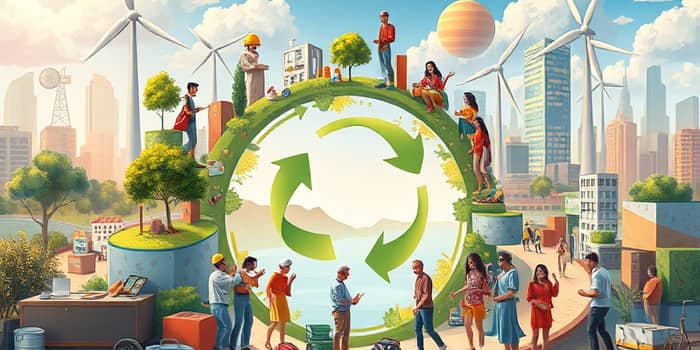
Picture a future where every product has a story of renewal, not disposal. This vision is at the heart of circular business models, a paradigm shift that challenges the old linear ways and invites us to reimagine commerce.
By design, these models eliminate waste and pollution, keeping resources in use indefinitely. They transform sustainability from a mere compliance task into a core driver of value creation.
Imagine businesses thriving not by exploiting finite resources, but by nurturing regenerative systems. This approach unlocks unprecedented potential for profit and planet alike.
The linear 'take-make-dispose' economy has led to environmental degradation and resource scarcity. Circular models offer a way out, turning challenges into opportunities for innovation.
They encourage us to think differently about ownership, consumption, and value. It is a journey towards a more resilient and equitable world.
Circular business models are built on principles of regeneration and efficiency. They aim to close material loops, ensuring that products and materials retain their highest value over time.
This requires a fundamental redesign of how organizations operate. Instead of focusing solely on sales, they emphasize services, maintenance, and recovery.
For example, companies might adopt strategies that extend product lifecycles through repair or use recycled inputs to reduce environmental impact. The goal is to create a system where waste is minimized and resources are continually circulated.
By doing so, businesses can reduce costs, foster innovation, and build stronger relationships with customers. It is a holistic approach that balances economic, environmental, and social goals.
There are several primary types of circular business models, each with unique strategies and benefits. The table below summarizes these types to provide a clear overview.
This table illustrates the diverse approaches available. Each type can be tailored to specific industries, helping businesses integrate circularity into their core operations for long-term success.
Across the globe, innovative companies are proving that circular models deliver tangible results. Here are some inspiring examples that showcase the power of this approach.
These stories highlight how circularity can drive both profit and purpose, turning environmental challenges into competitive advantages.
Circular business models offer a multitude of benefits that make them a powerful engine for sustainable growth. They go beyond environmental stewardship to create economic and social value.
Economic Benefits:
Environmental Benefits:
Social and Innovation Benefits:
Overall, these benefits position circular models as a strategic imperative for businesses aiming to thrive in a resource-constrained world.
Implementing circular models is not without hurdles, but with strategic planning, these challenges can be transformed into opportunities for growth.
By proactively addressing these challenges, businesses can pave the way for a smooth transition to circularity, unlocking new levels of resilience and innovation.
As we look ahead, the momentum for circular business models is accelerating. Digital enablers like IoT and blockchain are making it easier to optimize resource flows and track sustainability metrics.
Businesses of all sizes can start by assessing their current practices and identifying areas for circular innovation. Whether it is switching to recycled inputs, launching a repair service, or exploring product-as-a-service, every step counts towards a more sustainable future.
Embrace circularity not as a constraint, but as a catalyst for growth. By doing so, you contribute to a healthier planet while securing your company's future in an evolving market. Together, we can build a world where sustainability and prosperity go hand in hand, inspiring generations to come.
References