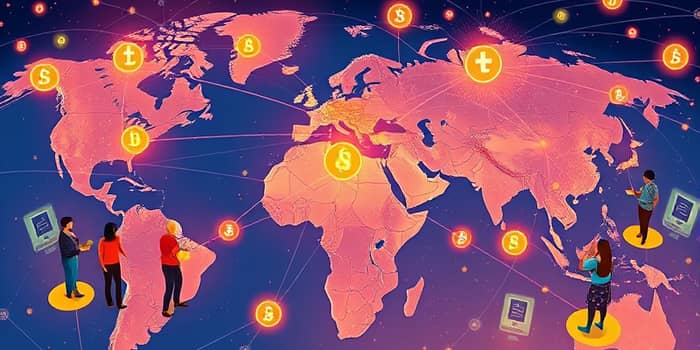
Decentralized finance is redefining how we interact with money, offering unprecedented accessibility and innovation. This article explores its growth, drivers, and practical implications for users worldwide.
The DeFi market is unlocking vast opportunities, with USD 51.22 billion in 2025 and projected to reach USD 78.49 billion by 2030 at an 8.96% CAGR. Alternative forecasts vary dramatically, reflecting different metrics and methodologies:
These discrepancies arise from definitions—TVL versus revenue—and forecast methodologies, underscoring the importance of context when interpreting data.
TVL is a critical barometer of DeFi adoption. As of early 2025, Total Value Locked (TVL) reached $129 billion, up 137% YoY. Ethereum commands 55% of this, while Solana holds 7.3% as the second-largest chain.
Layer-2 rollups processed USD 42 billion in Q1 2025, dramatically reducing fees. Solana’s TVL stands at USD 8–9 billion, facilitating 81% of global DEX trades. Leading protocols like AAVE report $24.4 billion TVL, with 19.8% growth in 30 days. RWA tokenization surged to $33.91 billion by Q2 2025, up 380% from early 2024 levels.
The positive drivers—rising TVL, clearer regulations in the US and EU, and efficient Layer-2 solutions—are partially offset by security vulnerabilities and compliance measures, which may slow growth.
DeFi’s ecosystem is diverse, catering to multiple use cases and geographies:
Regionally, Asia-Pacific leads with 19.50% CAGR, driven by Hong Kong and Singapore licensing stablecoins and institutional services. APAC adoption rose 69%, Latin America 63%, Europe 42%, North America 49%, and MENA 33%. Chainalysis ranked India #1 overall in DeFi interaction, followed by the US; Ukraine and Moldova top pop-adjusted metrics. TRM Labs cites Pakistan, Philippines, and Brazil as high adopters.
Ethereum remains the dominant DeFi chain, holding 55% of TVL at $129 billion. Other key players include:
Additional innovations include AI-driven robo-agents automating yield strategies and payment integrations bridging mainstream rails, further democratizing access.
As DeFi evolves, stakeholders can navigate the landscape effectively by:
Investors and developers should stay informed on RWA tokenization, which is poised to transform real-world asset access. Engaging with community governance and open-source protocols can offer early insights into emerging trends.
In conclusion, DeFi’s trajectory—from a niche experiment to a multi-hundred-billion-dollar industry—is driven by innovation, accessibility, and global reach. By understanding market projections, key drivers, and practical strategies, users can harness DeFi’s potential to build a more inclusive financial future.
References