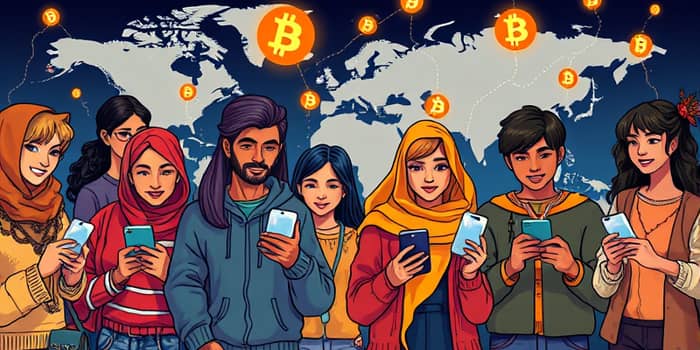
The financial technology revolution is redefining how individuals and communities engage with money. From mobile money in rural villages to AI-driven wealth management in cities, digital solutions are diminishing reliance on traditional banks and empowering people worldwide.
In just over a decade, developments in blockchain, mobile banking, and digital payments have enabled a shift reminiscent of leapfrogging from landlines to mobiles in telecommunications. Millions who once lived outside the formal banking system can now save, invest, and transact with a few taps on a phone screen.
Over the past fifteen years, innovations have dramatically transformed global financial landscapes. Account ownership soared from 51% in 2011 to 79% by 2025, propelled by mobile wallets, digital onboarding, and pandemic-driven shifts to online payment modes. Governments and startups alike focused on expanding access to financial services beyond traditional institutions and urban centers.
Pioneering mobile money schemes allowed users to send remittances, receive wages digitally, and access basic savings and credit products without branches. Concurrently, peer-to-peer lending platforms and robo-advisors opened capital markets to new demographics, while open banking regulations urged data sharing and competition.
Quantitative data illuminates both achievements and persistent gaps. Today, four in five adults hold an account with a financial institution or mobile money provider. Yet 1.4 billion people remain unbanked, especially in regions such as the Middle East and North Africa.
Usage metrics offer deeper insights: digital payment adoption in low- and middle-income countries jumped from 34% in 2014 to 62% in 2024, demonstrating how mobile technologies drive financial inclusion for the unbanked and underserved markets.
A diverse array of fintech solutions is fueling inclusion. Mobile wallets and digital banking platforms enable rural communities to send remittances and save securely. Crowdfunding, peer-to-peer networks, and AI-driven robo-advisors democratize access to capital and advisory services.
Underpinning these services are advanced technologies such as blockchain, machine learning, and open APIs, which have enabled leapfrogged infrastructure in emerging markets at a fraction of traditional costs. Digitized G2P payments further ensure transparency and timeliness.
Despite remarkable progress, significant challenges remain. Regulatory frameworks often struggle to keep pace with rapid innovation, creating uncertainty for both startups and consumers. Political instability and funding shifts can stall transformative programs, risking a stall in momentum.
Technological access is uneven, with connectivity gaps and digital literacy barriers excluding the most vulnerable. Without robust digital identity systems, many potential users cannot access formal services, inhibiting efforts at reducing dependency on centralized institutions and fostering local ownership.
Realizing a fully inclusive financial system demands concerted efforts across public and private sectors. Governments should continue digitizing G2P transfers, invest in reliable digital ID infrastructure, and establish regulatory sandboxes for emerging technologies.
Private-sector leaders must deepen collaboration with local institutions, commit to financial education initiatives, and tailor products to suit low-income and remote communities. Philanthropic organizations and development agencies can support pilot programs and capacity-building to refine models and scale successful interventions.
Central to this vision are public-private partnerships for sustainable growth that prioritize longevity, resilience, and equitable access. By integrating technology, policy frameworks, and human-centered design, stakeholders can unlock economic opportunities for billions more.
As we move forward, the lessons of the past decade offer a roadmap: continuing innovation, inclusive policy, and partnership-driven approaches can bridge the remaining divides, ensuring that finance truly serves as a catalyst for empowerment and shared prosperity worldwide.
References