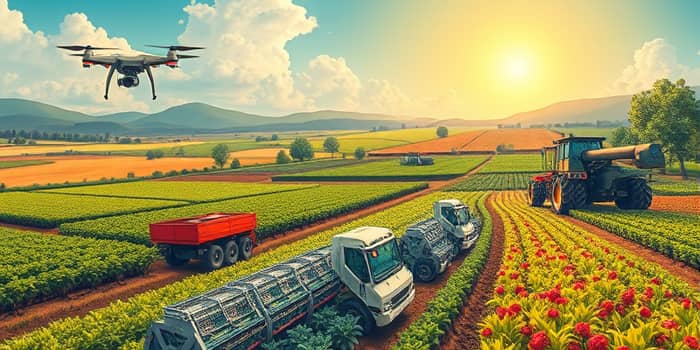
Global populations are growing, climates are uncertain, and traditional farming systems face unprecedented challenges. In this landscape, innovative AgTech solutions offer a beacon of hope. Across continents, entrepreneurs, investors, and policymakers are converging to secure our food supply and foster resilient agriculture. This article delves into the current investment surge, emerging technologies, financing structures, and strategic pathways that promise sustainable food security.
The past decade has witnessed a dramatic rise in capital flowing into agricultural technology. In 2024 alone, venture capital inflows reaching $16 billion underscored investor confidence in scalable farm solutions. While PitchBook’s Q1 2025 data reveals a slight cooling, with $1.6 billion invested across 137 deals, the focus has sharpened on startups displaying clear traction and proven field results.
Investors are diversifying across plant science, precision farming, livestock monitoring, and carbon credit platforms. Leading venture funds and corporate partners prioritize ventures that demonstrate both environmental benefits and solid financial returns. With advanced connectivity able to unlock an estimated $500 billion in agricultural GDP by 2030, the stakes have never been higher.
Beyond raw numbers, capital is channeling into solutions that address soil health, water scarcity, and climate resilience. Governments and development agencies are also stepping in, offering matching grants and policy incentives to catalyze private participation. Together, these factors are creating a vibrant ecosystem where innovation and sustainability intersect.
Today’s AgTech landscape is defined by a shift from small pilots to field-validated, scalable solutions that address real-world agronomic challenges. The 2026 agenda spotlights a range of breakthrough technologies reshaping every stage of the farm cycle.
Biologicals are transitioning into mainstream use, with distributors expanding offerings by 86%. Purpose-built robotics tailored for orchards, vineyards, and broadacre crops are automating labor-intensive tasks. Meanwhile, AI-driven predictive analytics delivering 30% yield accuracy boost are empowering farmers to optimize inputs, reducing costs and environmental impacts.
Water management innovations, such as nanobubble systems and precision irrigation, are rendering farms more resilient to drought and heat stress. Regenerative agriculture practices, tied to carbon credit markets, are incentivizing soil restoration and biodiversity. Across the board, digital platforms are knitting together data streams, enabling traceability from seed to shelf.
Innovative financing structures are key to bridging the gap between invention and adoption, especially for small and medium-scale operations. High upfront costs and cash flow constraints often deter early uptake of advanced tools, making tailored financial solutions essential.
By decoupling ownership from performance, these models shift risk and align incentives across stakeholders. Significant interest is growing around subscription services for farm management software and sensor networks, enabling data-driven decisions without onerous upfront investments.
Institutional lenders and development banks are expanding green finance portfolios, while agribusinesses invest directly or through joint ventures in startups. Such collaborations foster co-development, ensure real-world validation, and build resilient supply chains that serve both profitability and planetary health.
Despite remarkable progress, the path forward is not without obstacles. Economic volatility, unpredictable weather events, and persistent geopolitical tensions continue to disrupt agricultural production and trade. Ethical concerns around data privacy, algorithmic bias, and cybersecurity add complexity to technology adoption.
Addressing these hurdles requires concerted efforts from policymakers, private industry, and farming communities. Capacity-building initiatives, farmer training programs, and robust data governance frameworks are essential. Partnerships spanning public, private, and academic sectors can drive inclusive innovation and democratize access to critical resources.
As we approach 2030 and beyond, the convergence of technology, finance, and policy will determine how effectively we feed a projected global population of 9.7 billion. Emerging markets in Africa, Asia, and Latin America are poised for accelerated growth, fueled by mobile connectivity and tailored AgTech solutions.
Policymakers are increasingly recognizing the strategic importance of domestic food systems, integrating AgTech adoption into national development plans. Strategic initiatives like the USDA’s AI Strategy for 2025-2026 emphasize ethical infrastructure, open data platforms, and workforce training to enhance food safety, pest management, and supply chain resilience.
Ultimately, the true measure of success will be our ability to generate equitable benefits—ensuring that smallholder farmers, rural communities, and urban consumers all share in the gains. Through patient capital supporting long-term commercialization, startup consolidation, and cross-sector collaboration, the AgriTech revolution can deliver on its promise of a more secure, sustainable, and prosperous global food system.
By channeling resources into solutions with proven agronomic impact, driving inclusive financing, and nurturing resilient ecosystems, stakeholders worldwide can forge a future where food security is not a matter of scarcity but a testament to human ingenuity and cooperation.
References