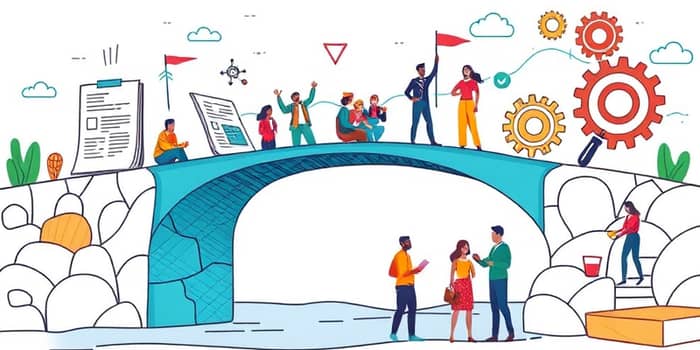
In the modern business landscape, a silent crisis undermines organizational success at an alarming rate.
The disconnect between strategic aims and practical implementation leaves countless brilliant plans gathering dust, unexecuted and forgotten.
This strategy-execution gap is not a minor hiccup but a pervasive issue that drains resources and morale.
Understanding its scale, causes, and solutions is the first step toward transformative change.
The numbers tell a sobering story of widespread failure and missed opportunities.
Research consistently highlights that most strategies never make it from paper to practice.
Harvard Business Review reports that 67% of strategies fail, a statistic that should jolt any leader into action.
Kaplan and Norton suggest an even starker reality, with up to 90% of strategies not executed successfully.
This gap translates into real-world consequences, from financial losses to eroded trust.
These failures are compounded by alignment problems within organizations.
Only one in three leaders believe their company has a well-defined strategy, creating confusion from the top down.
Meanwhile, 70% of strategists express concern over their inability to close the execution gap.
This misalignment leads to what experts call adrift companies, where low coordination and poor follow-through dominate.
Such organizations waste precious time, with employees spending about 392 hours per year in unproductive meetings.
That's nearly 16 workdays lost annually, a staggering overhead that hampers real progress.
To bridge the gap, we must first diagnose its origins, which span leadership, culture, process, and systems.
At the leadership level, the problem often begins with a failure in execution rather than strategy design.
Stephen Blandino identifies lazy leading, where leaders avoid extra work and focus on perks over vision.
This leads to undisciplined schedules and a lack of passion, making strategies dead on arrival.
Culturally, organizations struggle when they ignore how employees think and feel.
HBR authors emphasize that execution improves when people understand and connect their work to strategy.
Change fatigue and cynicism arise from repeated flavor-of-the-month initiatives without visible results.
This erodes trust and engagement, making it harder to rally teams around shared goals.
Process failures are another critical factor, often stemming from outdated or inefficient methods.
Technologically, many firms rely on manual, time-consuming systems that provide timely, actionable information too slowly.
This technology-induced gap frustrates teams and prevents real-time adjustments, as highlighted in strategy-gap frameworks.
One of the most significant barriers is the sheer disconnect between high-level planning and daily tasks.
Leaders may craft visionary goals but fail to translate them into tangible, coordinated activities at all levels.
This results in vertical misalignment, where corporate strategy isn't broken down into team objectives.
Horizontal misalignment occurs when departments pursue conflicting initiatives in silos.
Contrast strategy design, often confined to PowerPoint decks, with strategy in action, where real work happens.
Bridging this requires a shift from abstract concepts to concrete, measurable steps that everyone can follow.
Organizations can overcome these challenges by adopting frameworks, tools, and leadership behaviors that foster alignment.
Start by ensuring that strategy is clearly communicated and understood across all levels.
Use regular check-ins and feedback loops to maintain shared mindsets and assumptions.
Implement agile practices that allow for frequent adjustments based on real-time data.
Leadership must champion these changes by rolling up their sleeves and demonstrating commitment.
Avoid lazy leading by focusing on vision and empowering teams to take ownership.
Cultivate a culture where employees feel valued and connected to the bigger picture.
Process improvements should include breaking down strategies into manageable chunks.
Define success metrics early and track progress consistently to avoid drift.
Encourage cross-functional collaboration to eliminate silos and align efforts horizontally.
Technology plays a crucial role in bridging the gap by enabling seamless communication.
Implement tools that support dynamic planning and provide actionable information at speed.
This reduces the friction caused by manual processes and outdated systems.
Remember, bridging the strategy-execution gap is an ongoing journey, not a one-time fix.
By addressing root causes and implementing practical solutions, organizations can transform intent into impact.
This leads to sustained growth, innovation, and a competitive edge in today's volatile markets.
Embrace the challenge with determination, and watch your strategic visions come to life.
References