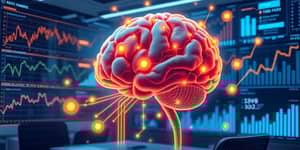
In today's financial landscape, traditional data analytics often fall short, missing the intricate web of connections that drive everything from fraud to investment success.
Graph AI emerges as a transformative solution, leveraging graphs and AI/ML to reveal hidden financial relationships with unprecedented clarity and speed.
This approach moves beyond static tables to dynamic networks, empowering professionals to act with confidence in real-time scenarios.
By modeling entities and their interactions, it uncovers patterns that are invisible to conventional methods, offering a new lens on risk and opportunity.
At its core, a graph is a data model consisting of nodes and edges, representing entities and their relationships.
In finance, nodes can include customers, accounts, merchants, securities, and more, while edges capture connections like transactions, ownership, or social ties.
Knowledge graphs add semantics, making these relationships machine-interpretable and enabling deeper insights.
Graph AI applies advanced techniques to this structured data, enhancing decision-making processes across the industry.
Key components include graph algorithms and graph neural networks (GNNs), which automate and scale analysis.
These tools allow for real-time multi-hop reasoning across vast datasets, transforming how financial data is utilized.
Finance is inherently relational, with every transaction and entity embedded in a complex network of interactions.
Traditional systems, relying on rows and columns, struggle to capture these dynamics, often collapsing context and limiting scalability.
Graph AI addresses these gaps by enabling explainability and adaptivity in financial analysis.
This makes it ground zero for innovation, particularly in areas like fraud detection and risk management.
Graph AI is not just theoretical; it has practical applications that are reshaping industries today.
From detecting fraudulent activities to optimizing portfolios, its impact is profound and measurable.
Fraudsters often operate in networks, using multiple accounts and devices to evade detection.
Graph AI uncovers fraud rings and mule networks by analyzing connections and patterns.
In anti-money laundering, it models complex chains across entities, triggering investigations proactively.
This leads to faster response times and reduced financial losses.
Moving beyond static scores, Graph AI enables network-aware credit risk assessment.
It incorporates relationship data, such as shared addresses or social ties, to provide a more holistic view.
This results in more accurate lending decisions and improved portfolio health.
Financial markets are interconnected, with shocks propagating through networks of companies and sectors.
Graph AI models these inter-company financial networks to assess contagion and systemic risk.
Platforms like RedGraphs quantify influence based on capital flows, not just size.
This proactive approach helps mitigate widespread financial disruptions.
Graph AI enhances portfolio optimization by incorporating network effects and relationship dynamics.
It uses GNNs to identify bridge nodes and network effects, boosting returns and diversification.
In venture investing, knowledge graphs predict future co-investments with high precision.
Studies show that network-derived features often outperform traditional financial metrics in predictive power.
This empowers investors to make data-driven decisions with greater confidence.
In regulated environments, transparency is crucial, and Graph AI provides auditable and explainable insights.
Knowledge graphs encode rules and relationships, serving as a policy infrastructure for compliance.
This builds trust with regulators and stakeholders, ensuring smoother operations.
Adopting Graph AI may seem daunting, but starting small can lead to significant gains.
Begin by identifying key data sources and relationships in your organization.
Focus on incremental updates and fine-tuning to adapt to changing financial landscapes.
Training teams on graph concepts and AI applications is also essential for success.
Graph AI is more than a technological upgrade; it's a paradigm shift in how we understand and navigate financial relationships.
By uncovering hidden connections, it offers practical help and inspiration for professionals across sectors.
From reducing fraud to optimizing investments, its benefits are tangible and far-reaching.
As finance continues to evolve, embracing Graph AI can provide a competitive edge and foster innovation.
Start exploring its potential today to transform challenges into opportunities in the interconnected world of finance.
References