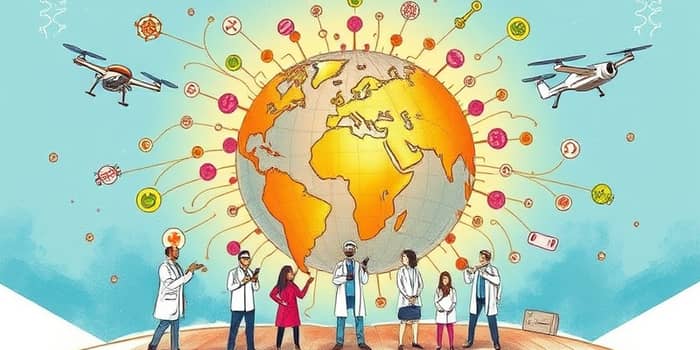
In an era defined by rapid technological breakthroughs and persistent health threats, the intersection of finance, technology, and global collaboration has never been more critical. From the breakthroughs in artificial intelligence to robust pandemic preparedness, investors and policymakers are reimagining how to safeguard lives while extending healthy lifespans. This detailed exploration offers a roadmap for stakeholders eager to turn ambition into actionable outcomes.
Over the past five years, venture capital and institutional funding have flocked to healthcare innovation. In 2025 alone, nearly $18 billion in US and European VC fueled companies leveraging AI to transform diagnostics, drug discovery, and personalized care. Remarkably, AI now represents 46% of all healthcare investment, underscoring its central role in the sector’s evolution.
Market projections suggest the global AI in healthcare market will expand from $39 billion in 2025 to $504 billion by 2032. North America currently leads with 49% of the global market share, while Asia-Pacific is fast emerging as a vibrant hub for healthcare IPOs, having raised over $30 billion through 25 sector debuts on the Hong Kong index in 2025.
Lessons learned from COVID-19 have spurred a renewed global commitment to outbreak prevention. The Pandemic Fund’s third funding round in February 2026 allocated $499.6 million to 20 projects, mobilizing over $4 billion in co-investment from domestic and international partners. This surge follows historical lows: from $0.18 billion in 2013 to just $0.48 billion in 2017, marking a reversal toward proactive resilience.
Projects now span single-country initiatives—such as disease surveillance upgrades in Senegal and laboratory system enhancements in Papua New Guinea—to regional collaborations across the Lake Chad Basin. By integrating the One Health approach, these grants foster coordination between human, animal, and environmental health sectors, creating early warning systems that can detect zoonotic threats before they escalate.
While capital floods into digital therapeutics and AI-driven drug discovery, demonstrating return on investment remains a challenge. Over half of health systems report they have yet to measure AI’s financial returns or consider it too soon to assess. However, 31% note moderate financial returns from AI, and 3% celebrate significant ROI on pilot programs. This emerging evidence fuels confidence that strategic deployments can enhance productivity, lower costs, and improve clinical outcomes.
Integration hurdles persist, including data interoperability, workforce training, and regulatory alignment. Successful models in Asia and Africa underscore the necessity of investing across the entire ecosystem: from digital infrastructure and supply chains to governance frameworks and local talent development. Blended finance structures—combining donor grants, impact investment, and public-private partnerships—are proving effective for scaling AI solutions in low- and middle-income regions.
The lines between biotech, pharma, and digital health are fading. Collaborations like the Nvidia-Eli Lilly AI drug discovery lab exemplify the power of convergent innovation. Companies that integrate advanced therapeutics with data-driven platforms are attracting the lion’s share of capital, while stand-alone digital health funding has slowed to 0.5% of total health investment.
Innovators focusing on healthspan and longevity technologies saw a 2.3× increase in investment in 2025, suggesting a shift toward preventative and wellness-oriented solutions. Yet, three large deals accounted for most of this growth, highlighting the need to diversify funding across early-stage pioneers exploring novel biomarkers, personalized nutrition, and regenerative medicine.
U.S. global health policy is realigning with national security and economic priorities. The America First Global Health Strategy emphasizes deal-based diplomacy over traditional grant aid, seeking measurable ROI and strategic co-benefits. While this approach promises efficiency, sudden funding cuts and restructuring risk leaving fragile health systems underprepared.
Independent analysts warn that sustained reductions in multilateral support could result in between 9.4 and 22.6 million additional deaths by 2030. To avoid such outcomes, stakeholders must advocate for equitable investment that balances security interests with the needs of underserved communities. The High-Level Independent Panel recommends allocating an additional 1% of GDP toward national health budgets and raising $15 billion in annual development assistance for pandemic preparedness over the next five years.
As we stand at the crossroads of unprecedented challenges and opportunities, the imperative is clear: we must harness cutting-edge technologies, foster global partnerships, and deploy capital in ways that yield both measurable impact and long-term resilience. Investors, policymakers, and innovators share a common mission—to protect populations from emerging threats while extending healthy longevity for all.
By aligning incentives across public and private sectors, embracing blended financing models, and committing to data-driven decision-making, we can transform ambition into action. Whether you are a venture capitalist evaluating the next wave of startups, a health minister shaping national budgets, or a research team developing the tools of tomorrow, the path forward requires collaboration, vision, and unwavering dedication.
Together, we can build a future where pandemic preparedness is not an afterthought but an integrated pillar of health systems, and where longevity innovations are accessible to every community. Let this be our defining endeavor: to invest boldly today for the health and vitality of generations to come.
References