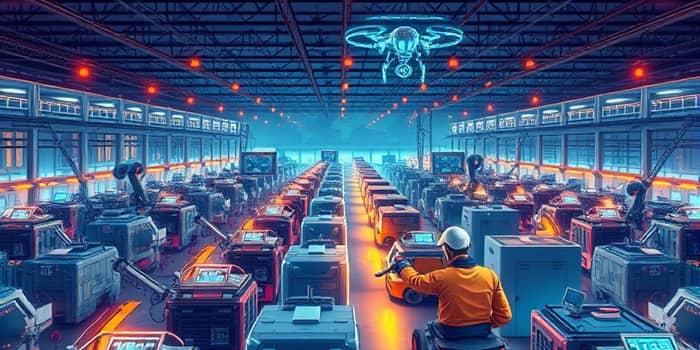
The manufacturing sector stands at a pivotal crossroads. Fueled by rapid technological advances, evolving workforce dynamics, sustainability mandates, and the pressure of geopolitical and supply chain shifts, companies worldwide must adapt or risk obsolescence. In this new era, success is measured not only by output but by resilience, agility, and environmental stewardship.
Industry 4.0 is no longer a futuristic concept—it is the beating heart of modern production. By embedding hyperconnectivity via IoT, AI, and robotics, manufacturers unlock unprecedented visibility and control. In 2023, the global Industry 4.0 market reached $114.3 billion in value, and analysts forecast a CAGR exceeding 20% through 2032.
Smart factories are graduating from isolated pilot programs to real-time monitoring and analytics at scale. Generative AI has moved beyond proofs of concept, enhancing maintenance diagnostics, optimizing design, and even tailoring workforce training. The predictive maintenance market grows 25% annually, using sensors and machine learning to foresee equipment failures, cut downtime, and extend machinery life.
Geopolitical tensions, natural disasters, and fluctuating trade policies underscore the need for supply chain resilience. By integrating AI, blockchain, and real-time analytics, manufacturers cultivate end-to-end visibility and transparency. Digital risk mapping pinpoints vulnerabilities, while regionalized supply bases mitigate cross-border uncertainties.
Autonomous vehicles—drones, self-driving forklifts, and AGVs—streamline logistics and warehouse operations, compensating for labor shortages and enhancing safety. Companies like Henkel already deploy drones for inventory audits and driverless forklifts for intra-factory transport, setting a new standard for efficiency.
Environmental responsibility has evolved from compliance checkbox to strategic imperative. Manufacturers now embed emissions reduction and energy efficiency strategies into year-over-year planning. Solar panels, wind turbines, and green microgrids power facilities, while eco-friendly materials and circular design principles minimize waste.
The circular economy emphasis—designing for disassembly, reuse, and recycling—extends product lifecycles and reduces raw material consumption. By setting ambitious carbon neutrality targets, companies win consumer trust and preempt tightening regulations.
Automation investment is fueling a surge in productivity and precision. Collaborative robots (cobots) work alongside human operators, freeing teams to focus on creative and strategic tasks. Additive manufacturing (3D printing) supports mass customization without high costs, delivering tailored components on-demand and shrinking lead times.
The digital revolution demands a workforce fluent in data analytics, automation, and IT/OT convergence. With Gen Z entering the job market, manufacturers highlight technology-driven, purpose-focused manufacturing roles to attract talent. Upskilling initiatives, apprenticeships, and partnerships with universities bridge the skills gap and create career pathways.
As operations become software-defined, cybersecurity emerges as a board-level priority. Cyberattacks can halt production and compromise intellectual property. Manufacturers adopt ethical AI, robust cybersecurity, and governance frameworks to safeguard data integrity, ensure compliance, and build stakeholder confidence.
Decentralized manufacturing—minting microfactories and regional hubs—enhances responsiveness and slashes transport emissions. Tailoring robotics to local needs and coupling them with renewable microgrids delivers resource-efficient, agile production even in remote regions.
Hyperautomation orchestrates AI-driven systems to automate entire workflows in real time, tying together ERP, IoT, and MES platforms. This real-time, AI-powered workflow automation dynamically adjusts schedules, energy usage, and logistics by factoring in weather, demand spikes, or new trade policies.
A 2025 Deloitte survey reveals that 80% of manufacturers plan to allocate at least 20% of improvement budgets to smart factory initiatives. Yet technology is only one side of the coin—leadership must champion both digital and sustainability transformations simultaneously. Forward-thinking CEOs are appointing dedicated CIOs and CSOs to drive enterprise-wide adoption and ensure cross-functional alignment.
To navigate this era of constant change, executives should focus on:
Manufacturing’s new era demands bold vision and decisive action. By embracing digital transformation, fortifying supply chains, prioritizing sustainability, and nurturing talent, organizations can thrive amid uncertainty. The path forward is clear: integrate technology with human ingenuity, optimize processes for planetary health, and build resilient ecosystems that endure. Together, these strategies will shape a manufacturing landscape defined by innovation, agility, and responsibility.
References