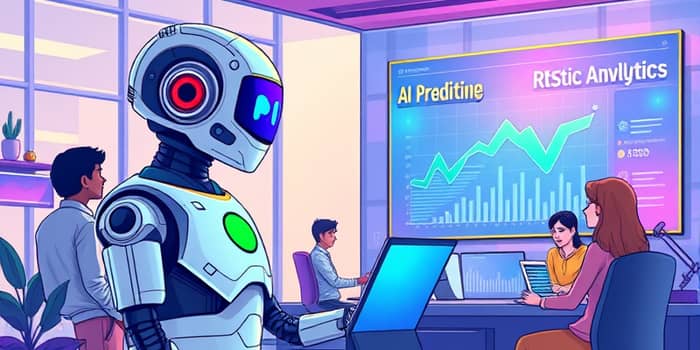
In the fast-paced world of finance, a revolution is quietly unfolding where technology not only responds to needs but anticipates them.
Predictive service bots are at the forefront, merging machine learning models with AI to offer proactive insights.
This shift transforms client interactions from reactive queries to foresight-driven service.
Imagine a financial advisor that knows you need a loan before you even ask.
That is the power of these innovative systems.
Predictive service bots combine predictive analytics with AI chatbots to forecast trends.
They analyze data like spending patterns and market signals to anticipate needs.
This approach moves beyond traditional support to provide personalized financial guidance in real-time.
By leveraging historical and real-time data, these bots can predict everything from investment opportunities to potential risks.
This proactive stance helps clients make better decisions faster.
It empowers financial institutions to stay ahead in a competitive landscape.
The backbone of predictive service bots lies in advanced technologies.
Here are the key components that make them effective:
These elements work together to create dynamic forecasting models.
They enable bots to adapt to changing market conditions swiftly.
This technology integration is what drives the proactive capabilities.
Predictive service bots are already making a significant impact across various financial sectors.
They enhance efficiency and client satisfaction through diverse applications.
These use cases demonstrate how bots address real-world financial challenges.
They help clients achieve their goals with tailored recommendations.
Financial institutions benefit from improved accuracy and reduced costs.
The advantages of predictive service bots are quantifiable and impactful.
They deliver tangible results that enhance both client and business outcomes.
These benefits highlight the proactive anomaly spotting capabilities.
They enable financial firms to operate more sustainably.
Clients enjoy better service and financial health as a result.
Several companies have successfully implemented predictive service bots.
These examples show the practical impact in everyday finance.
These success stories illustrate investment optimization in action.
They provide a roadmap for other institutions to follow.
By learning from these cases, firms can adapt similar strategies.
Despite their benefits, predictive service bots come with challenges.
Addressing these risks is crucial for successful implementation.
Common issues include data quality gaps and regulatory scrutiny.
Over-reliance on models in volatile markets can lead to errors.
To overcome these, follow a structured implementation roadmap.
Best practices emphasize hybrid human-AI collaboration.
Bots can prepare data for agents to enhance decision-making.
Focus on proactive surveillance to stay ahead of risks.
Measure ROI through metrics like default rates and accuracy.
This approach ensures sustainable growth and compliance.
The future of predictive service bots in finance is bright and innovative.
They are poised to drive further automation and accuracy.
Emerging trends include generative models for scenario simulation.
Prediction model factories will enable more targeted offerings.
Full customer experience data loops will support strategic growth.
These advancements promise real-time decisions with greater precision.
Early adopters will gain a competitive edge in the industry.
As technology evolves, bots will become even more integral to finance.
They will help democratize access to financial services globally.
By embracing this future, institutions can foster resilience and innovation.
Predictive service bots are not just tools; they are partners in financial success.
References