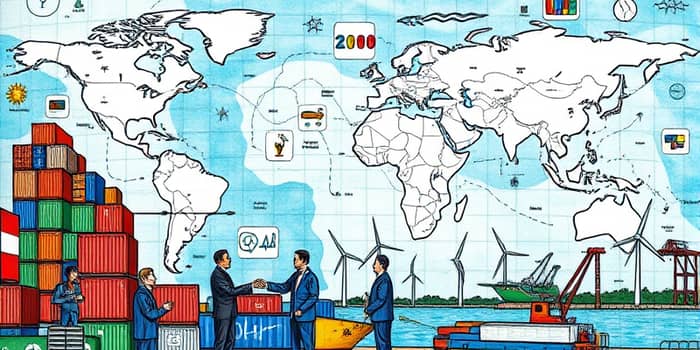
As the world economy embarks on the latter half of 2025, global commerce stands at a historic inflection point. The past year has witnessed an unprecedented expansion of cross-border transactions, with trade values soaring and new deals reshaping economic alliances.
Yet beneath these headline figures lies a complex web of strategic interests, asymmetric bargains, and mounting critiques. This examination aims to unravel current frameworks and propose pathways to a more sustainable and inclusive trade landscape.
In the first half of 2025, global trade value expanded by about 500 billion dollars, surging beyond earlier forecasts and signaling robust economic activity. According to recent UNCTAD estimates, goods trade grew approximately 2.5 percent quarter over quarter, driven by strong manufacturing output in Asia, resurgent consumer electronics demand in Europe, and an uptick in hybrid and electric vehicle shipments from North America to emerging markets. This momentum is underpinned by both sustained consumer spending and renewed investment in infrastructure and green technology components. Energy fuels and processed metals also posted significant gains as commodity prices rebounded, highlighting the interplay between raw material availability and downstream manufacturing capacity.
Services trade rebounded strongly after a Q1 contraction, with digital platforms, professional consultancy, and logistics services recording double-digit growth in certain subregions. Developing economies led the expansion, with intra-regional trade among South American and African nations flourishing as export corridors diversified and tariff barriers eased. While global merchandise trade volumes plateaued in some mature markets, price increases not volume were the primary driver of overall value gains, as producers passed higher input and transportation costs on to buyers. Forecasts from the WTO suggest that, barring geopolitical shocks, 2025 will surpass 2024’s record trade value by a margin of 3 to 4 percent, emphasizing the resilience of interconnected economies amid shifting policy landscapes. However, analysts caution that this price-led growth is vulnerable to inflationary pressures and currency fluctuations, which may temper gains in the latter part of the year.
Across multiple continents, bilateral and plurilateral pacts inked in 2025 are redefining the rules of engagement. In Asia, landmark arrangements with China have suspended export controls on rare earths and critical minerals for a year, while securing agricultural purchases that promise to reshape American farm exports through 2028. Parallel agreements with South Korea, Vietnam, Malaysia, Cambodia, and Thailand collectively lower or eliminate tariffs on a wide range of goods and establish new mechanisms for supply chain resilience. In Europe, the US-EU Framework on Reciprocal, Fair, and Balanced Trade commits to zero tariffs on industrial goods and unlocks unprecedented energy and semiconductor investments. Meanwhile, the UK-US Economic Prosperity Deal grants duty-free aerospace access and calibrated quotas for critical sectors. Together, these deals illustrate both ambition and caution in a fluid global environment.
While each agreement targets specific industries—agriculture, automotive, energy, technology—the cumulative effect is a network of overlapping obligations and strategic hedges. Governments have prioritized digital trade and technology provisions to secure the flow of data and protect intellectual property, even as environmental clauses like carbon border adjustment mechanisms gain traction under the EU-US framework. This mosaic of commitments showcases both innovation in trade policy and the enduring challenge of harmonizing disparate national objectives into coherent global norms.
The United States has adopted a negotiating stance that many observers describe as highly asymmetric, extracting tailored concessions while extending limited reciprocal market access. Under this model, partner countries agree to deep tariff cuts on priority sectors, enhanced cross-border data flows, and robust export control cooperation, often in exchange for modest increases in US purchases of targeted goods. Critics point to five central commitments underpinning this approach, reflecting both economic and strategic imperatives:
Although this framework can yield swift results, it carries risks. Critics point to the erosion of the authority of the multilateral system as bilateral deals circumvent traditional WTO dispute mechanisms. They also warn of a race-to-the-bottom regulatory competition dynamic, where competitors vie for investment by offering subsidies or lowering environmental and labor standards. Addressing these concerns requires a careful balance between flexible, targeted agreements and broader rules that preserve fair competition.
Despite impressive headline numbers, underlying vulnerabilities persist. Trade imbalances—especially the US-China surplus—have narrowed only marginally, while the EU’s surplus dipped modestly. Conversely, deficits widened in regions like Japan, India, and the UK as domestic demand outpaced export capacity. UNCTAD warns of persistent policy uncertainty and protectionist responses to industry overcapacity, which could prompt sudden tariff spikes or export restrictions. Moreover, volatile geopolitics, particularly between major trading powers, threaten to fragment supply chains and increase the cost of compliance with new security measures.
Stakeholders increasingly advocate for a revitalized WTO that can adjudicate disputes over digital trade, environmental safeguards, and subsidy practices. Expanding the WTO’s mandate to oversee climate-related measures and data governance could help restore faith in multilateralism. However, reforming this institution will demand significant compromise from member states accustomed to negotiating exclusive bilateral or regional pacts.
Two overarching themes emerge from recent agreements: the imperative of supply chain security measures to guard against disruptions, and the integration of environmental objectives into trade rules. Agreements now routinely include clauses to prevent dumping of surplus semiconductors, regulate transshipment routes for critical minerals, and secure pharmaceutical supply chains. Climate considerations feature prominently, with carbon border adjustment mechanisms and green subsidies entering the discourse. At the same time, digital platforms and cross-border data flows are governed by detailed protocols, ensuring that technology transfer aligns with national security and privacy standards.
Developing nations are no longer passive bystanders in this new order. As South–South trade flows reach record levels, countries in Africa, Latin America, and Southeast Asia are forging their own pacts to reduce dependency on traditional markets. This diversification fosters economic resilience and truly inclusive growth strategies by opening new avenues for small and medium enterprises. Embedding technical assistance and capacity-building into these agreements further strengthens local value chains and promotes sustainable development.
Rethinking global trade agreements demands a dual strategy: immediate engagement through focused bilateral and regional deals, coupled with a long-term commitment to multilateral reform. Policymakers must integrate digital governance, climate policy, and security considerations into cohesive global standards. Reviving and modernizing the WTO, while aligning national incentives, can foster a more transparent and equitable system.
The challenge ahead is to convert the remarkable momentum of 2025 into structural resilience. By balancing asymmetrical bargains with robust multilateral oversight, the international community can build trade frameworks that deliver prosperity, protect vulnerable stakeholders, and steward the planet. In so doing, nations will chart a sustainable course toward shared growth and cooperation.
References