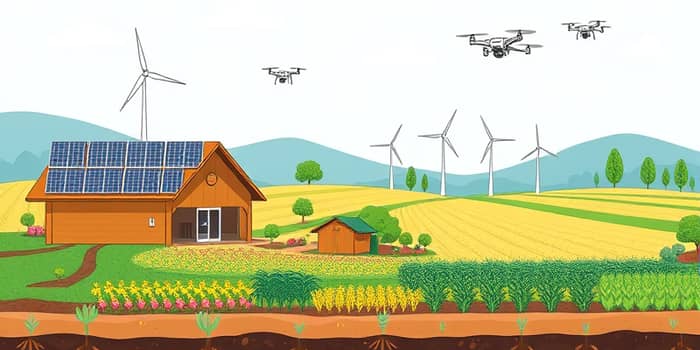
In an era defined by climate urgency and growing populations, sustainable agriculture emerges not just as an ethical imperative but as a compelling investment opportunity.
The global food system stands at a crossroads, facing unprecedented challenges from environmental degradation to resource scarcity.
This article delves into the structural drivers, market dynamics, and key themes that underpin the investment thesis for sustainable agriculture, offering insights for forward-thinking investors seeking to align profit with purpose.
Sustainable agriculture is propelled by a confluence of powerful macro forces reshaping the agricultural landscape.
Rising food demand necessitates feeding 9.7 billion people by 2050, all while reducing environmental impact.
Climate change exacerbates risks, with agriculture contributing significantly to global greenhouse gas emissions.
For instance, about 11% of EU GHG emissions stem from agricultural activities, highlighting the need for decarbonization.
Environmental degradation from heavy reliance on synthetic inputs poses structural risks, driving a trend toward de‑chemicalization of agriculture.
Consumer pull is strong, with global organic food sales reaching USD 148.48 billion in 2023, fueled by health and environmental awareness.
Policy and corporate commitments, such as net-zero targets, further accelerate this transition.
Technology inflection points, including AI, robotics, and precision farming, lower costs and improve return on investment.
The sustainable agriculture market is poised for robust growth, with estimates highlighting significant expansion potential.
In 2024, the market size is projected between USD 15.35 to 15.43 billion, indicating a solid foundation for future growth.
Forecasts vary by source but consistently show mid-teens compound annual growth rates.
This growth is driven by increasing adoption of sustainable practices across regions.
Key sub-segments contribute to this growth, each offering unique investment opportunities.
Sustainable agriculture encompasses diverse themes that attract investor interest.
De‑chemicalization and biologicals represent a shift away from synthetic inputs toward sustainable alternatives.
Biological fertilizers and biopesticides are gaining traction due to regulatory and environmental pressures.
Regenerative and climate‑smart agriculture practices enhance resilience and carbon sequestration.
Cover cropping and reduced tillage improve soil health, reducing input costs over time.
Carbon farming and ecosystem services offer monetization opportunities through carbon credits.
Global carbon farming market is projected at a CAGR of approximately 11.58% from 2023 to 2028.
AgTech and digital transformation are critical enablers, with AI driving efficiency gains.
These technologies lower barriers to sustainable practices, making them more accessible.
Different regions exhibit varying levels of adoption and growth potential in sustainable agriculture.
North America holds the largest market share, driven by strong consumer demand and policy incentives.
Key players like Deere & Company and Corteva are headquartered here, fostering innovation.
Europe benefits from a strong regulatory push, such as the EU Green Deal, promoting decarbonization.
Initiatives like the EUR 50 million InSoil regenerative fund support carbon farming projects.
Asia‑Pacific is expected to expand significantly due to population growth and rising middle-class demand.
Opportunities abound in smallholder farmer solutions and water-efficient practices.
Latin America and Africa offer emerging opportunities in bioenergy and climate-resilient cropping.
Investing in sustainable agriculture requires balancing opportunities with inherent risks.
Key investment cases include technologies that enable de‑chemicalization and biological inputs, reducing environmental harm.
Regenerative practices offer improved soil health and carbon sequestration, aligning with global climate goals.
AgTech innovations provide scalable solutions for resource optimization, enhancing farm profitability.
However, risks such as regulatory changes and market volatility must be carefully managed.
By addressing these risks, investors can build resilient portfolios in this dynamic sector.
As the world grapples with feeding a growing population under climate constraints, sustainable agriculture presents a transformative investment thesis.
By leveraging technology, embracing regenerative practices, and responding to consumer and policy tailwinds, this sector offers long-term growth and resilience.
Investors poised to engage with this dynamic field can contribute to a more sustainable future while achieving competitive returns, making it a win-win for people and planet.
References