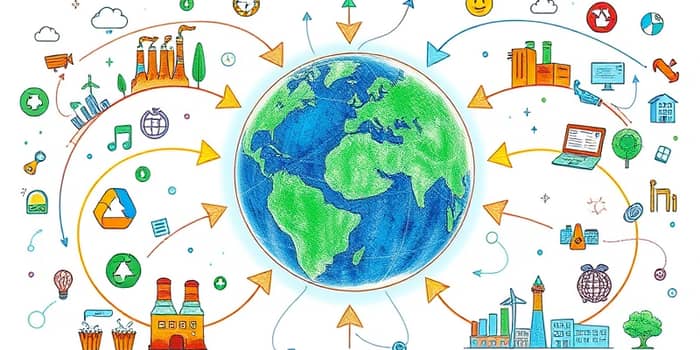
In today's rapidly evolving world, the circular economy is not just an environmental concept but a compelling investment opportunity.
It represents a fundamental shift from the wasteful linear model to a sustainable loop that maximizes resource value.
This transition is driven by urgent global challenges and offers significant financial rewards for forward-thinking investors.
As resource depletion accelerates, embracing circularity becomes essential for both planet and profit.
The circular economy keeps materials and products in use for as long as possible.
It extracts maximum value before recovering and regenerating them at end of life.
This model reduces waste and lowers resource use, enhancing supply chain resilience.
By acting as a second supply source, it mitigates dependence on volatile primary extraction.
Key macro drivers include:
These factors make the circular economy a major global investment theme with profound implications.
The global circular economy market is expanding rapidly, offering lucrative opportunities.
In 2023, it was valued around USD 553–556 billion, signaling robust initial traction.
By 2030, projections suggest it could reach approximately USD 1.32–1.34 trillion.
This represents a compound annual growth rate (CAGR) of ~13.2% from 2024–2030, outpacing many traditional sectors.
Alternative estimates are even more optimistic, with some forecasting USD 2.204 trillion by 2034.
Digital circular solutions are a fast-growing segment, with the market for software and analytics set to exceed $1.7 billion by 2027.
Circular industries have grown 3.1% faster than linear ones since 2020, highlighting their accelerated momentum.
This growth is underpinned by strong regulatory support and technological advancements.
Circular economy business models are diverse and highly scalable.
Technology segmentation reveals critical enablers:
These models create substantial value pools across industries, driving innovation and efficiency.
Various industries are embracing circularity, each with unique opportunities.
The fastest-growing vertical is waste management and recycling, with a CAGR of ~14.4%.
Electronic waste alone is expected to reach $107.62 billion by 2029, showcasing explosive potential.
Investors can target these sectors for diversified exposure and high returns.
Policy is a key catalyst for circular economy growth, varying by region.
Key policies include extended producer responsibility laws, like California's Responsible Textile Recovery Act.
After COP30, many countries are strengthening commitments to circular critical mineral supply chains.
Global standards, such as the WBCSD protocol, provide common metrics for measuring circularity.
Leading asset managers view the circular economy as a key thematic opportunity alongside energy transition.
Goldman Sachs highlights it for enhancing supply chain resilience and mitigating geopolitical risks.
Investors are drawn to cost savings, efficiency gains, and alignment with sustainability goals.
Why investors care:
Practical steps for investors include focusing on high-potential sectors and leveraging technology.
By monitoring regulatory developments, investors can capitalize on emerging opportunities.
The circular economy is more than a trend; it is a fundamental shift in resource valuation.
Investing in this theme drives positive change while delivering robust financial returns.
Embrace this transformative journey to build a sustainable and prosperous future.
References