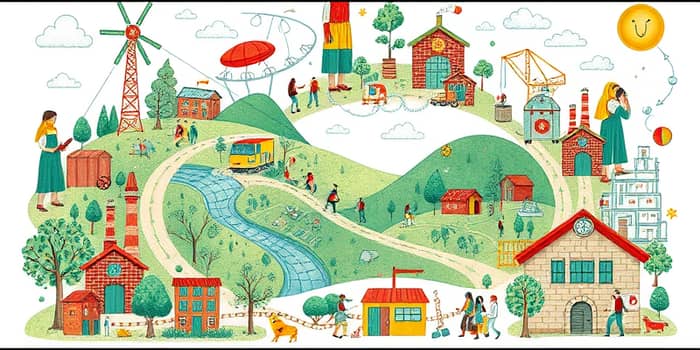
In an era of mounting environmental challenges and resource scarcity, the circular economy emerges as a transformative blueprint for businesses and societies. By reimagining traditional supply chains and product lifecycles, companies can unlock new value streams while preserving ecosystems and driving social progress.
The take, make, waste linear model relies on extracting raw materials, manufacturing products, and discarding them at end of life. This approach generates high volumes of waste and increases environmental pressure through continuous resource depletion.
In contrast, a circular economy ensures that products and materials are kept in circulation as long as possible. Strategies such as maintenance, reuse, refurbishment, remanufacturing, and recycling work in concert to minimizing waste and pollution impacts.
An innovative circular business model framework explains how an organization creates, delivers, and captures value for stakeholders while reducing ecological and social costs. By moving from ownership to access models, firms shift from selling products to providing outcomes, aligning profitability with sustainability.
Adopting circular strategies offers multiple advantages that drive long-term resilience and competitiveness:
Frameworks from the Ellen MacArthur Foundation, OECD, and World Economic Forum converge on core circular business model types:
Transitioning to a circular model involves a structured approach. First, map material flows across your value chain to identify hotspots for improvement. Assess product lifecycles and prioritize design changes that facilitate disassembly and recovery.
Next, establish robust reverse logistics capable of collecting used products and materials. Collaborate with suppliers, partners, and logistics providers to create efficient take-back systems. Integrate digital tools—such as IoT sensors and blockchain—to track product status and condition in real time.
Finally, set clear performance metrics focused on material recovery rates, resource productivity, and social impact. Embed these KPIs into management processes to ensure continuous improvement and stakeholder accountability.
Across industries, circular initiatives are delivering measurable benefits:
Government and industry policies play a critical role in accelerating the circular transition. Extended producer responsibility schemes compel manufacturers to manage end-of-life products. Stricter waste and recycling targets push companies to innovate in eco-design and material substitution.
Carbon pricing and green public procurement further reward circular practices by aligning economic incentives with climate goals. Investors and stakeholders increasingly scrutinize supply chain sustainability, making circular commitments a central component of corporate strategies.
Despite clear benefits, several challenges must be addressed:
Looking ahead, digital technologies such as AI-driven sorting, blockchain for product traceability, and advanced materials science will shape the next wave of innovation. Urban mining—recovering rare earth elements from e-waste—and localized circular hubs promise to decentralize production and foster resilient local economies.
The circular economy is more than a sustainability trend: it is a fundamental shift in how value is conceived and delivered. By embracing circular business models, organizations can achieve competitive advantage, manage risks, and contribute to a healthier planet for future generations.
References