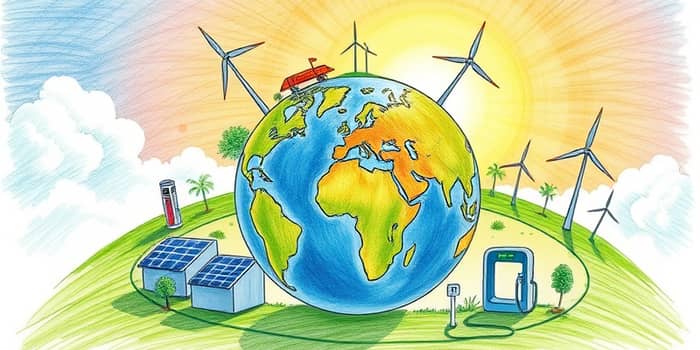
As the world confronts the twin challenges of climate change and energy security, a profound shift is unfolding. Investment in clean energy has surged to unprecedented heights, transforming the global power landscape and offering a blueprint for a sustainable future.
Between 2024 and 2025, global energy transition spending reached a record-breaking $2.3 trillion, an 8% increase from the previous year. This remarkable growth signals an irreversible shift to clean technologies and underscores the rising confidence of investors, policymakers, and communities in renewable solutions.
In 2025 alone, global clean energy investment climbed to $2.2 trillion, accounting for two-thirds of total energy spending. Renewables, electrified transport, and grid upgrades are at the heart of this transition, delivering both environmental benefits and robust returns.
Half-year data from 2025 reveals $386 billion poured into clean energy in just six months, a 10% year-on-year increase. This momentum reflects a growing recognition that renewable projects can outcompete fossil fuels on cost, reliability, and scalability.
This record investment dwarfs the annual GDP of many nations and demonstrates that clean energy is no longer a niche sector—it is the primary driver of power infrastructure growth worldwide.
While the energy transition is a global phenomenon, several regions stand out for their leadership and innovation.
Across all regions, renewables are now the default choice for new power generation. In the first three quarters of 2025, solar and wind met 100% of electricity demand growth, reinforcing their role as growth engines.
The energy transition rests on a diverse set of technologies, each playing a critical role in decarbonizing power systems and end-use sectors.
Other emerging areas—sustainable aviation fuels, small modular nuclear reactors for data centers, and advanced grid management—are beginning to attract attention and capital, promising further diversification.
Despite the impressive investment surge, challenges remain. Policy uncertainty, permitting delays, and financing costs can slow project development. In the United States, post-incentive additions of solar, wind, and storage are expected to moderate to between 30 GW and 66 GW per year from 2026 to 2030.
Yet momentum is on the side of clean energy. Cost declines for solar panels and batteries, combined with attractive risk-adjusted returns, are drawing traditional energy investors into the sector. Sustainable firms often enjoy lower capital costs and higher valuations, reinforcing the virtuous cycle of investment.
To translate this momentum into lasting impact, stakeholders can:
Looking ahead, the energy transition will be shaped by three intertwined imperatives: security, resilience, and competition. While climate goals remain vital, energy independence and supply stability will increasingly guide policy choices.
Emerging markets in Asia and Africa are poised to become new frontiers for cleantech investment, leveraging modular solar, battery microgrids, and off-grid solutions to leapfrog traditional infrastructure constraints.
By 2030, global renewable capacity could surpass 4,600 GW of new additions, with solar accounting for 80% of growth. The green economy’s value, already over $5 trillion in 2024, may exceed $7 trillion within a decade, reflecting the scale of opportunity for innovators, investors, and communities worldwide.
Each of us—policymakers, entrepreneurs, financiers, and consumers—plays a role in this extraordinary transition. By embracing clean energy today, we can build a future powered by sustainable innovation and collective action, ensuring prosperity for generations to come.
References