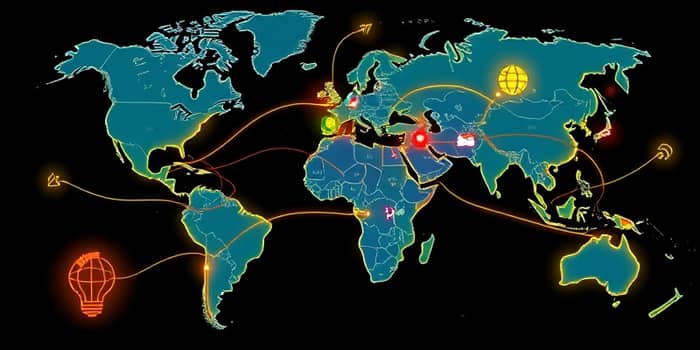
Venture capital is undergoing a profound transformation. No longer confined to Silicon Valley, funding is flowing into new regions and sectors, driven by technological breakthroughs and changing investor priorities. This article explores how startups and investors can navigate this evolving landscape.
In 2025, global VC funding reached $202.3 billion, marking a rebound from slower years. AI captured nearly half of all investment, reflecting the technology’s central role in today’s innovation economy. While the U.S. still commands roughly 65% of deal value, other regions are surging.
Quarter 2 saw $101.05 billion across 7,356 deals, stabilizing when a major OpenAI outlier is excluded. Europe raised $14.6 billion in the same quarter, and Asia recorded $12.8 billion, despite China hitting a ten-year low of $4.7 billion. India’s fintech and mobility sectors emerged as bright spots, attracting increasing capital and global attention.
Behind these figures lies a shift from unchecked valuations toward a more disciplined approach. Startups are expected to demonstrate clear paths to profitability, and investors are focusing on sustainable, scalable businesses. This new paradigm sets the stage for targeted growth and healthier ecosystems worldwide.
Several interconnected trends define the current VC landscape. First, a broad valuation correction prioritizing profit over growth has taken hold. The era of “growth at all costs” has given way to more rigorous due diligence, especially for late-stage rounds.
Second, AI’s dominance is unmistakable. Generative models, developer tools, and specialized databases continue attracting mega-deals. With hyperscalers committing over $300 billion in capex, competition for breakthroughs is fierce. Investors are seeking companies with unique data moats and real-world applications.
Third, IPO and M&A activity is rebounding. A wave of unicorns with solid financials is preparing for public markets or strategic exits, unlocking liquidity for limited partners. Private equity’s $4 trillion in dry powder further fuels the resurgence of mega-deals and acquisitions.
Fourth, corporate venture capital has evolved. CVCs now pursue more deliberate, targeted AI partnerships, balancing strategic objectives with financial returns. Independence from parent firms has become crucial as CVCs adapt to tighter budgets and higher performance expectations.
Finally, the market is cleaning up. Hundreds of “zombie” startups and underperforming funds have closed, restoring balance. Healthy restructuring has reset expectations, avoiding the hyper-inflation of valuations witnessed in 2021 and 2022.
While the U.S. remains the largest VC market, decentralization is in full swing. Europe’s resilience, India’s rapid growth, and pockets of innovation across Asia and the Americas are reshaping investment flows.
These shifts reduce overreliance on a single ecosystem. Emerging hubs offer lower costs, diverse talent pools, and supportive policies. For founders, proximity to local investors and strategic partners can accelerate growth.
In this dynamic environment, both founders and backers must adapt their playbooks. For entrepreneurs, building defensible technology moats is paramount. Especially in AI, unique datasets and proprietary models underpin long-term success.
Cost management is equally critical. Recent tariff reforms and supply-chain disruptions require agile sourcing strategies. Startups that can pivot quickly and optimize expenses will emerge stronger.
For VCs and LPs, selectivity is essential. Prioritize sectors with measurable long-term growth potential, such as climate tech, biotech, and spacetech. Due diligence should extend beyond financials to include regulatory landscapes and geopolitical risks.
The VC correction of 2025 is laying the groundwork for a more resilient, diversified market. Investors expect a rebound in exit activity, and founders have access to an unprecedented array of funding sources across multiple geographies.
However, macro uncertainties persist. Rising interest rates, evolving trade policies, and regulatory scrutiny in AI and defencetech may create headwinds. Stakeholders must remain vigilant, balancing optimism with disciplined risk management.
Ultimately, the decentralization of venture capital heralds a new era of opportunity. By focusing on profitable, scalable business models and forging strong regional partnerships, startups and investors alike can thrive beyond Silicon Valley’s shadow.
This transformative moment invites all participants to think globally, act strategically, and shape the future of innovation from every corner of the world.
References