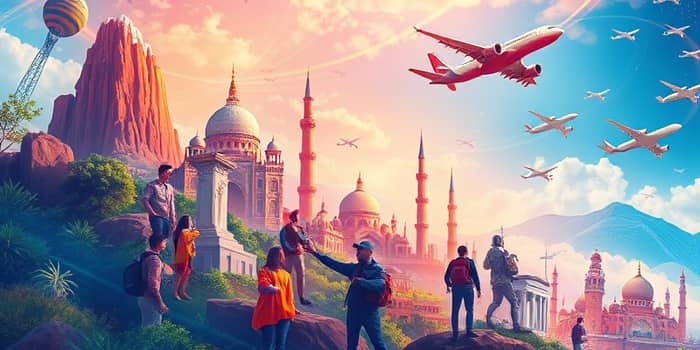
In 2025, the world witnessed an extraordinary turning point in travel. International arrivals topped 1.1 billion in just nine months, notably surpassed pre-pandemic record levels. This milestone underscores a sector that is not only recovering but also transforming at an unprecedented pace.
After the deepest collapse in tourism history—a 1.1 billion drop in arrivals during 2020—the industry bounced back rapidly. By 2024, arrivals had fully matched 2019 figures, and early indicators for 2025 signal continued momentum.
What once seemed like a distant dream has become reality, as people worldwide crave new experiences and connections.
The path from lockdowns to full airplanes was anything but straightforward. Accelerated by vaccine rollouts in 2022, international travel regained strength despite Omicron-related setbacks. Strong consumer demand continued through 2024 and into 2025, even amid inflationary pressures on tourism services.
TSA throughput during recent winter holidays rose by 7% year-over-year in the United States, demonstrating sustained domestic enthusiasm. Globally, domestic visitor spending climbed to US$5.3 trillion, up 5.4% from 2023, while international spending reached US$1.9 trillion, a remarkable 11.6% increase.
Travel & Tourism’s resurgence has reasserted its role as an economic titan. In 2024, the sector contributed a staggering US$10.9 trillion to global GDP—accounting for 10% of the world economy—and supported 357 million jobs, or one in ten positions worldwide.
By 2034, forecasts predict 30 billion tourist visits and a sector contribution of US$16 trillion—over 11% of global GDP—driven by innovation and expanding markets.
The United States presents a nuanced picture. The National Travel and Tourism Office (NTTO) anticipates 77.1 million international arrivals in 2025 (up 6.5% from 2024), rising to 90.1 million by 2027. Yet, other projections foresee a 6.3% decline to 67.9 million arrivals in 2025, citing economic headwinds and changing consumer confidence.
Travelers today seek more than sightseeing—they crave immersion. A shift toward a booming experiential travel trend emphasizes authenticity, proximity, and off-the-beaten-path exploration.
Tourism operators are responding with custom itineraries that showcase hidden gems, encourage community engagement, and foster genuine connections.
Artificial intelligence is reshaping the travel experience. From personalized recommendations to VIP concierge services, AI powers powerful real-time data analytics, enabling travelers to tailor every detail of their journey.
Major airlines and hotel chains leverage machine learning to optimize pricing, predict demand, and automate service delivery. Meanwhile, mobile apps integrate augmented reality, guiding visitors through cultural sites and nature trails with immersive digital overlays.
Despite optimism, the road forward presents significant headwinds. High inflation in tourism services erodes purchasing power, while geopolitical tensions and shifting policy landscapes introduce uncertainty.
Addressing these challenges demands collaboration between governments, industry stakeholders, and local communities.
Looking beyond 2025, sustainability emerges as the guiding principle. The WTTC prioritizes net-zero targets, destination stewardship, and embrace sustainable and responsible tourism practices that protect natural and cultural assets.
Innovators are exploring carbon-neutral transport, eco-friendly accommodations, and regenerative travel models that give back to host communities. Meanwhile, emerging markets in Asia-Pacific and the Middle East are set to reshape the global tourism map, presenting fresh opportunities for investment and cultural exchange.
For businesses, success will hinge on adaptability. Strategies that emphasize personalization, leverage emerging affluent segments, and integrate cutting-edge tech will drive growth. Above all, the industry’s most profound transformation lies in its collective ability to foster connections, inspire wonder, and build a more resilient, inclusive future for travelers and communities alike.
References