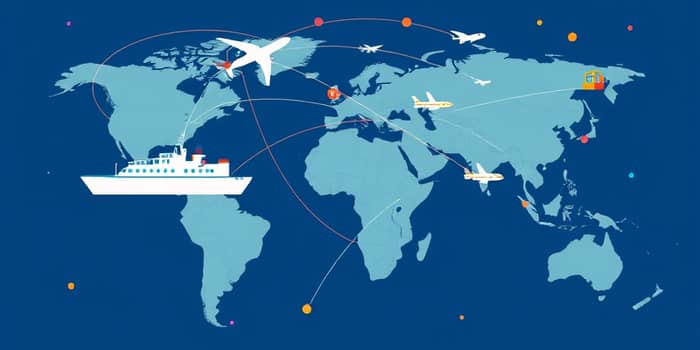
As we navigate towards 2026, the world of international commerce stands at a crossroads, shaped by slowing growth and geopolitical realignments.
Global trade volume growth is projected to ease to roughly 0.5%, down from approximately 2.4% in 2025, signaling a period of subdued economic activity.
This deceleration highlights the critical need for strategic adaptation and resilience in how countries and corporations approach trade.
Embracing this change requires understanding the new frameworks emerging from fragmentation.
It is a call to action for leaders to innovate and collaborate in ways that foster inclusive growth.
The traditional model of global trade is giving way to a multi-nodal patchwork, reorganizing around four main nodes.
These include the US, China, the Plurilateralists, and BRICS+ nations excluding China.
Each node sets its own rules and engages with the world based on national and collective interests.
This shift represents a move away from centralized governance towards regional strongholds.
It demands that businesses and governments rethink their strategies for market access.
Such projections underscore the importance of aligning with nodes that offer growth potential.
Adapting to this decentralized system can unlock new opportunities for trade diversification.
Global tariffs have risen in 2025, largely driven by US measures, affecting manufacturing sectors the most.
Governments are expected to continue using tariffs in 2026 to pursue industrial and strategic objectives.
This trend increases uncertainty, discourages investment, and disrupts supply chains.
Smaller and less diversified economies are most exposed to these volatile conditions.
The US has shifted from traditional Free Trade Agreements to bilateral framework deals.
This assertive approach elevates economic nationalism and hard-power trade tools.
It necessitates that businesses prepare for frequent policy shifts and compliance complexities.
Nearly two-thirds of global trade occurs within value chains being reshaped by geopolitical tensions.
Firms are diversifying suppliers and relocating production closer to key markets to reduce risk.
Africa and Latin America are strengthening South-South links to offset weaker demand in advanced economies.
This redistribution happens within aligned networks while diversifying across partners.
To thrive, organizations must embed compliance into trade execution and leverage technology.
Embracing these steps can transform challenges into competitive advantages.
Environmental commitments are increasingly shaping trade as climate pledges move from ambition to implementation.
The Carbon Border Adjustment Mechanism (CBAM) transition phase has ended, with a definitive regime planned for 2026.
CBAM is likely the first in a series of carbon borders expected in the UK, Japan, and other jurisdictions.
Carbon pricing and clean-energy markets are redefining competitiveness globally.
Pledges by 113 countries could cut emissions by about 12% by 2035, driving green trade initiatives.
Developing countries will need access to green finance and technology to stay competitive.
This shift offers a chance to build sustainable and inclusive trade ecosystems.
Critical minerals prices fell sharply after 2022 as supply expanded faster than demand.
This decline eased costs for clean technologies but weakened investment in new mining projects.
Environmental, social, and security-driven rules are expanding further in 2026.
Strategic initiatives include the Critical Minerals Action Plan and Quad Critical Minerals Initiative.
These efforts highlight the importance of securing supply chains for future technologies.
Businesses must anticipate and adapt to these evolving regulatory landscapes.
Trade compliance is becoming more complex, interconnected, and enforcement-driven across sanctions and export controls.
Asia-Pacific enforcement updates increasingly intersect with US and EU export-control objectives.
Organizations modernizing by integrating data and technology will be best positioned to manage risk.
The strategic elevation of the trade function is essential for resilience in this new era.
This table illustrates the growth trajectories under the multi-nodal framework.
It serves as a guide for strategic planning in uncertain times.
Slower growth limits investment in infrastructure and industrialization for developing nations.
Smaller and less diversified economies are most exposed to rising tariff costs and trade volatility.
Stronger regional trade and diversification are critical to build resilience against shocks.
Flexible global rules and targeted assistance are key to ensuring inclusive trade.
By focusing on these areas, developing countries can navigate the complexities of the new trade landscape.
Global trade in 2026 faces mounting pressure from slower growth, fragmentation, and green transitions.
These forces reshape trade flows and investment decisions, with risks and opportunities concentrated in developing economies.
Negotiations on the US-Mexico-Canada Agreement (USMCA) could determine future integration trends.
China's trade with the Global South may encounter barriers if imbalances are addressed.
Plurilateralist nations intend to further diversify trade away from both the US and China.
To succeed, businesses must expect continued movement in tariffs and growing export control restrictions.
Long-term implications for supply chains and investment strategy require proactive planning.
By defining clear partnership strategies and embedding compliance, we can turn challenges into catalysts for innovation.
This new framework invites us to build a more resilient and equitable global trade system.
Let us seize this moment to forge alliances that drive sustainable growth for all.
References