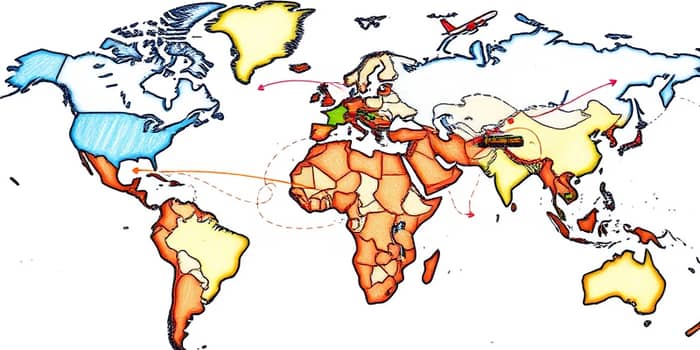
As the world economy braces for a new era, trade routes are poised to transform under the weight of politics, climate, and technology. Businesses and nations alike must prepare for unprecedented shifts in where and how goods travel.
By 2035, global trade in goods, services, and resources is forecast to expand from about $33 trillion in 2024 to $45 trillion in real terms. That represents roughly 35% growth in real terms over the next decade, under McKinsey’s baseline scenario. Yet this projection masks deep uncertainties.
Two alternative scenarios illustrate the stakes:
Under a high-fragmentation world, around a quarter of expected trade growth could evaporate, and more than 30% of trade volumes might swing from one corridor to another by 2035. In the short term, UNCTAD reported a 4% gain in goods trade in early 2025, suggesting growth with significant turbulence.
Despite geopolitical headwinds, certain corridors shine as reliable growth engines. McKinsey highlights routes that outperform the global 2.7% growth baseline across all scenarios.
These connections benefit from rapid GDP expansion, industrialization, and integration into broader value chains. For instance, ASEAN nations assemble Chinese intermediates for export to advanced economies, while India’s manufacturing boom creates new hubs for pharmaceuticals, automotive parts, and electronics.
Investors can tap into opportunities by funding ports, logistics centers, and digital platforms that serve India-centric and South-South corridors. Financiers should also develop innovative trade-finance solutions tailored to emerging-market risk profiles.
Conversely, traditional corridors linking advanced economies to China and Russia risk steep declines under fragmentation. Trade in critical goods with these partners could plunge from 15% to just 2% of global volumes by 2035. Europe’s pivot away from Russian gas—from 45% of its mix to a target of zero by 2027—already illustrates long-term rerouting of energy supplies.
The broader narrative is a shift from G2-centric globalization toward regionalized, politically aligned blocs. Companies must reassess supplier networks, seeking partners within safer political ecosystems.
Since 2017, new tariffs and industrial policies have discouraged trade with geopolitically distant economies. In a fragmentation scenario, 20% tariffs could apply broadly—except when flows transit through exempt “connecting economies.” This leads to sophisticated rerouting, where China ships components to Southeast Asia or India for final assembly before onward delivery to advanced markets.
Recent sanctions on Russia and Iran, along with tightening technology export controls, have underscored the need for rapid adaptation. Service providers specializing in sanctions compliance, transshipment hubs and connector countries, and geopolitical risk analytics will thrive as firms seek to de-risk supply chains.
Key maritime chokepoints—the Suez and Panama Canals, the Straits of Hormuz and Malacca—face mounting pressures from climate-driven low water levels, regional conflicts, and piracy. Disruptions in the Red Sea during 2024 demonstrated the fragility of long‐established sea lanes.
As delays mount, shippers are exploring longer alternative routes around Cape of Good Hope, and pursuing modal shifts to air and rail for high-value or time-sensitive cargo. Businesses should develop contingency plans, pre-contracting space on alternative routes and diversifying carrier partnerships.
The Northern Sea Route (NSR) along Russia’s Arctic coast offers a shorter link between Northern Europe and Northeast Asia—up to 30% time savings compared to Suez. Since 2010, non-Russian vessels have completed iron-ore voyages via NSR, and traffic is expected to double as ice recedes.
However, high ice-class vessel costs, the need for escorts, environmental regulations, and geopolitical risk limit near-term scalability. Still, niche operators can seize seasonal freight for bulk commodities.
Overland “middle-corridor” routes through Central Asia and the Caucasus provide strategic optionality. China’s Belt and Road Initiative corridors, combined with Eurasian rail services, offer redundancy though at higher per-unit costs. Firms moving high-value electronics or life-science products will find these rails faster and more predictable than some maritime paths.
Maritime volumes are redistributing toward South Asia, Africa, and Latin America, stretching port capacities and hinterland connections. Port operators must invest in berthing capacity, automation, and hinterland rail links to handle surges.
Meanwhile, air freight is gaining share for urgent shipments. Advances in drone delivery and electric aircraft could further reduce lead times in the next decade. Companies should evaluate whether premium air freight contracts can protect time-sensitive revenue streams.
Rail corridors, particularly between China and Europe, will continue to expand. While pricier than sea, trains outpace ships by two weeks on average. Logistics planners should blend modalities—combining rail for mid-route segments with coastal shipping for bulk legs—to optimize cost and speed.
Policy leaders should streamline customs procedures, incentivize green shipping, and support resilient infrastructure in underdeveloped corridors.
The coming decade offers both promise and peril for global trade. As routes fragment and new corridors emerge, businesses that anticipate shifts will capture growth and mitigate risk. By investing in versatile logistics, forging partnerships in resilient markets, and embracing modal innovation, stakeholders can transform uncertainty into a launching pad for competitiveness.
The future of global trade is not a one-size-fits-all network but a dynamic tapestry of routes shaped by politics, climate, and technology. Those who adapt quickly will navigate this complexity to find new opportunities across the world’s ever-changing horizons.
References