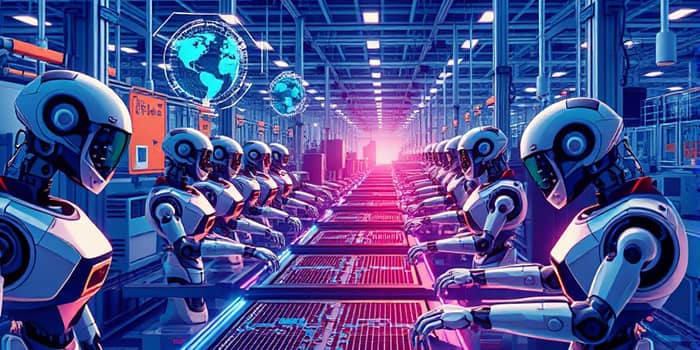
In 2026, the manufacturing landscape stands at a crossroads of rapid technological evolution and shifting global investment patterns. Companies around the world are racing to harness breakthroughs in automation, artificial intelligence, and smart infrastructure. Those who embrace these changes with agility, vision, and strategic alignment will define the next era of industrial leadership. This article explores key trends, practical strategies, and investment drivers that will determine competitive success in the coming years.
Artificial intelligence has moved beyond experimentation to become a core component of modern production. Today, 95 percent of manufacturing firms have allocated resources to AI or plan to within five years. Despite near-universal interest, only 20 percent report being fully prepared to operationalize insights at scale. The gap between ambition and readiness underscores the need for structured roadmaps and cross-functional collaboration.
Manufacturing executives are committing significant portions of their digital budgets to AI. A recent survey found that 80 percent of executives intend to invest at least one-fifth of their improvement budgets in smart manufacturing initiatives. These investments target predictive maintenance, quality control, and supply chain optimization, delivering tangible improvements in uptime and efficiency.
Physical AI—robots with increased autonomy—has progressed from laboratory prototypes to factory floors. Today, 22 percent of manufacturers plan to deploy these systems within two years, more than doubling current adoption rates. Collaborative robots, or cobots, now handle tasks alongside humans in 57 percent of automotive production lines.
From robotic dogs patrolling warehouses to humanoid assistants navigating unstructured environments, advanced robotics are redefining task automation. Companies report an 18 percent surge in robot orders during Q2 2025, driven by the pursuit of flexible electric vehicle assembly and vision-guided inspection technologies that ensure consistent quality at scale.
Digital twin technology has emerged as a cornerstone of modern manufacturing strategy. With the market projected to reach $34 billion in 2026, nearly half of global adopters are in the industrial sector. These virtual replicas of physical assets enable real-time simulation, process optimization, and predictive maintenance modeling.
When paired with edge computing and IoT sensors, digital twins provide actionable insights at the machine level. Manufacturers leveraging this combination report development cycles up to 50 percent faster and unplanned downtime reductions of 20 percent. Pharmaceuticals firms, in particular, use these systems for automated batch compliance and serialization tracking.
Global supply chains are undergoing a profound shift toward nearshoring and reshoring. An overwhelming 84 percent of manufacturers seek technologies and partners to reduce geopolitical risk and bring production closer to end markets. Factors such as a weakened dollar, lower corporate tax rates, and a skilled workforce in the United States bolster this trend.
Digital enablement plays a critical role in regionalized networks. Connected data, predictive analytics, and advanced forecasting tools allow companies to balance cost control with responsive delivery. This transformation fosters regionalized supply chain networks that combine agility with transparency.
The United States has witnessed a surge of private-sector commitments exceeding $500 billion to revitalize semiconductor manufacturing. Incentives such as an increased advanced manufacturing investment credit, permanent full expensing for new equipment, and streamlined permitting for semiconductor facilities have catalyzed capacity expansion.
Data center growth and funding for small modular reactors have further diversified investment flows into advanced manufacturing. Startups raised $3.9 billion for modular nuclear solutions in 2024 alone. Policy frameworks like America’s AI Action Plan and deregulation efforts aim to cement US leadership in next-generation industrial technologies.
While core technologies cut across sectors, applications vary by industry. Automotive manufacturers prioritize humanoid robots and EV line flexibility. Food and beverage producers adopt IP69K-rated cobots for hygienic wash-down environments. Electronics firms implement plug-and-produce modular cells, and pharmaceutical companies accelerate digital twin adoption for compliance.
Effective automation is not one-size-fits-all. Companies must select the right level of automation based on product mix, volume, and labor dynamics. High-volume operations favor end-to-end robotics, while specialized producers may focus on vision systems and smart material handling to deliver customization and responsiveness.
Despite abundant opportunities, manufacturers face critical hurdles. A widening technology readiness gap means that while 98 percent explore AI, only one in five feel fully prepared. Talent shortages, particularly in middle market firms, constrain full adoption of digital solutions.
Addressing these challenges requires sustained investment in workforce upskilling and development, robust cybersecurity protocols, and disciplined execution. Companies that prioritize resilience and cost transparency will thrive even amid economic uncertainty.
The future of manufacturing is defined by the convergence of advanced automation, strategic investment, and agile supply chain models. Organizations that adopt a robust data strategy essential for predictive insights and forge deep partnerships across technology and policy ecosystems will outperform peers.
As global investment flows intensify and digital capabilities mature, the winners in 2026 will be those who combine innovation with disciplined execution. By balancing flexibility with resilience, manufacturers can unlock new levels of productivity, quality, and sustainable growth in the years ahead.
References