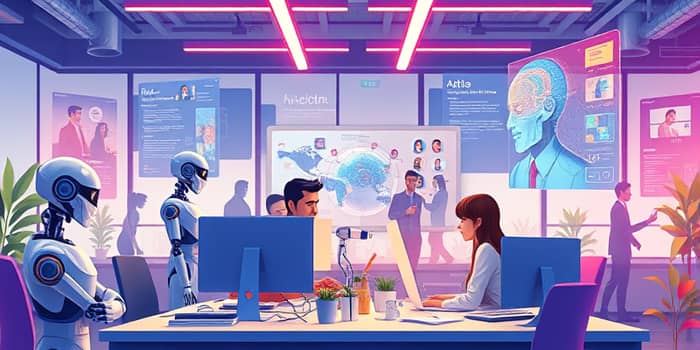
In an era defined by rapid technological advances, shifting demographics, and evolving employee expectations, organizations and individuals alike face unprecedented opportunities and challenges. The traditional notions of work, talent acquisition, and career development are being upended by forces that demand fresh thinking, strategic adaptation, and collaborative resilience.
Understanding these changes and responding proactively is essential for businesses seeking growth, workers striving for fulfillment, and policy makers aiming to foster inclusive prosperity.
Four key structural drivers are converging to transform how work is organized and how talent flows across industries and borders. Recognizing these forces helps leaders anticipate disruptions and harness emerging advantages.
These drivers interact in complex ways. For example, AI and automation accelerate productivity, but also heighten the urgency around reskilling and ethical use. Meanwhile, demographic shifts exacerbate talent gaps in critical fields like cybersecurity and healthcare, threatening trillions in unrealized revenue if unaddressed.
Traditional office-bound models are giving way to hybrid, remote, and flexible arrangements that blend physical and virtual spaces. By the end of 2025, 70% of knowledge workers will be remote at least five days a month, making hybrid the default rather than the exception.
To thrive in this environment, organizations must craft a meaningful workplace value proposition that offers more than desks and coffee. According to design experts, offices are evolving into spaces for personal growth, collaboration, and transformational experiences, forming what has been dubbed the “Transformation Economy.”
Meanwhile, the gig and contingent workforce is expanding, projected to comprise half of all workers by 2027. Managing this collective workforce with diverse contracts requires new compliance frameworks, culture-building strategies, and continuous learning pathways.
Certain sectors face acute hiring pressures. Technology roles—particularly in AI, cybersecurity, and data infrastructure—command premium compensation and near-full employment, with unemployment in tech at just 2.8%. In logistics and certified trades, shortages driven by retirements and training bottlenecks intensify wage competition.
Wage dynamics are diverging sharply. High-demand specialists may see pay hikes of 5–8% by year-end, while more commoditized positions rely on efficiency gains rather than salary increases. In hospitality, rising food costs constrain wage growth, pushing operators to optimize processes and offer flexible schedules instead of higher pay.
Recruitment challenges persist: nearly 70% of organizations report difficulty filling full-time roles. Top decision drivers for candidates include salary, flexibility, technology, culture, and values. Employers are rethinking acquisition strategies, emphasizing speed, candidate experience, and targeted outreach to stand out in competitive markets.
The skills that underpin organizational success are shifting toward both technical expertise and human-centric capabilities. As routine tasks become automated, creativity, problem-solving, and emotional intelligence take center stage.
Employers are abandoning degree-centric models in favor of skills-based hiring, with 81% adopting such approaches in 2024. This shift enables more agile internal mobility and fluid development ecosystems embedded in work, supported by AI-driven personalization and predictive analytics in learning and development.
Investments in L&D have surged as companies train employees for new roles to mitigate shortages. Over one-third of organizations now upskill workers for cross-functional tasks, while retention efforts anchored in career paths and coaching have increased by 60% in two years.
Leaders must recalibrate strategies across talent acquisition, workplace design, and learning to navigate the evolving landscape. Key actions include:
Embracing a skills-centric operating model enhances agility, while predictive analytics in HR can reduce turnover by up to 50%. Leaders who foster human–AI collaboration and prioritize employee well-being will unlock innovation and drive sustainable growth.
For workers, the future offers both promise and responsibility. Self-driven learning, flexibility, and adaptability become essential. As careers become more fluid, individuals must curate their skill portfolios and networks.
Policy makers play a pivotal role in supporting this transition by investing in lifelong learning infrastructure, updating labor regulations for gig and remote work, and promoting equitable access to digital tools. Public-private partnerships can address training bottlenecks and bridge talent gaps.
By working in concert—businesses, individuals, and governments can create an inclusive, resilient future of work. Embracing change with empathy, foresight, and collaboration will ensure that talent markets evolve in ways that benefit all stakeholders, unlocking human potential in the age of AI and beyond.
References