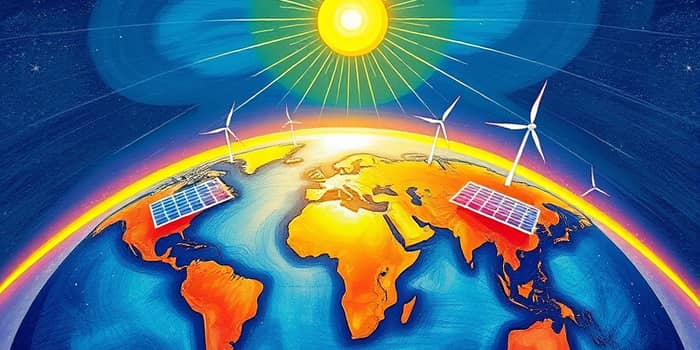
In a world grappling with climate change, the surge in renewable energy investments is a beacon of hope, driving transformative change across the globe.
Record-breaking figures reveal a historic shift towards clean energy, with global commitments reaching unprecedented heights.
This movement is not just about numbers; it's a practical roadmap for a sustainable future, offering inspiration and actionable insights for nations and individuals alike.
Global investment in new renewable energy projects soared to $386 billion in the first half of 2025.
This represents a 10% increase from the same period in 2024, setting a new benchmark for clean energy finance.
Total renewable energy investment hit $728 billion in 2024, supporting a record 741 GW of capacity addition.
The growth is driven by offshore wind and small-scale solar, even as utility-scale solar faces challenges.
Renewables generated 10% more electricity in 2024 than 2023, highlighting their expanding role in the global mix.
Different regions are shaping the investment landscape in unique ways, with some surging ahead while others face hurdles.
Here is a summary of key regional trends:
This regional diversity underscores the need for tailored strategies to accelerate the energy transition.
Investments are not uniform across technologies, with solar and wind dominating the scene.
Solar PV contributed 602 GW in 2024, making up 81% of new capacity additions.
However, utility-scale solar faced a 19% decline in early 2025 due to concerns over curtailment.
Wind energy, especially offshore, saw investments of $39 billion in the first half of 2025.
Other technologies like nuclear are also resurging, with a 50% increase over five years.
Key points to note include:
These trends highlight the dynamic evolution of energy technologies.
Several factors are propelling this investment surge, making renewables more accessible and attractive.
Falling costs for solar panels have been a major catalyst, reducing barriers to entry.
Corporate demand for green energy is rising, driven by sustainability goals and consumer pressure.
Policy support, such as auctions and incentives, plays a critical role in many countries.
Community ownership models, like those in Denmark, foster local engagement and investment.
Electricity demand growth globally ensures a market for new renewable capacity.
These drivers are essential for maintaining momentum in the face of challenges.
Despite the progress, significant obstacles remain that could slow the transition.
Revenue risks from curtailment and negative prices threaten project viability in some regions.
Policy shifts, such as in the US post-election, create uncertainty for investors.
High costs for offshore wind outside China limit its deployment in certain markets.
Investment growth is slowing, with a 6% increase in 2025 compared to 17% in 2022.
Broader context includes extreme weather events and global temperature rises, emphasizing the urgency.
Renewables grew in 75 out of 79 countries from 2017 to 2024, showing widespread adoption.
Capital is shifting to high-return areas, but this requires careful management to avoid disparities.
The shift to renewables is not just environmental; it brings tangible economic benefits.
Countries like Ireland have saved €840 million since 2000 through wind and solar investments.
In Spain, electricity prices dropped by 20% as renewables increased by 20% from 2021 to 2024.
China ranks 12th in the Energy Transition Index for 2025, reflecting its leadership role.
These savings underscore the financial advantages of clean energy, making it a smart investment.
Here are additional economic insights:
To understand the global leadership, here is a table highlighting key nations based on renewable electricity share.
This table illustrates the diverse approaches to energy transition across nations.
For governments, businesses, and individuals, engaging with renewable energy is crucial for a sustainable future.
Invest in diverse technologies to mitigate risks and capitalize on opportunities.
Support policies that stabilize investment climates and encourage innovation.
Focus on community-based projects to build local support and resilience.
Monitor global trends to adapt strategies and stay competitive.
Key actions include:
By embracing these steps, we can accelerate the path to a cleaner, more prosperous world.
The global landscape of renewable energy investments is evolving rapidly, offering hope and practical solutions.
With record investments and technological advances, the transition is within reach.
Challenges like policy uncertainty and revenue risks must be addressed through concerted efforts.
Ultimately, this journey requires collective commitment and innovation from all sectors of society.
Let this inspire you to participate in the renewable energy revolution, for a brighter tomorrow.
References