As nations grapple with shifting geopolitical fault lines, surging energy demand, and urgent climate pledges, energy independence has emerged as both a strategic ambition and an investment frontier. From Beijing to Brussels, policymakers and capital allocators are navigating competing priorities: securing supply, fostering industry, and decarbonizing at pace.
The legacy of the Russia–Europe gas crisis, coupled with Red Sea shipping threats and US–China tensions, has reignited concerns over geopolitical fractures and supply risks. Simultaneously, industrial policy has shifted from free-market orthodoxy toward industrial policy and job creation, with onshoring and friend-shoring at the forefront.
Finally, the accelerating climate emergency and air-quality concerns drive governments to embed climate imperatives and clean growth into national strategies. These three overlapping drivers are rewriting energy roadmaps around the world:
Yet the tension is stark: global primary energy consumption rose ~2% in 2024—outpacing the 2010–2019 average—led by China (+4%) and India (+5%). Electricity demand surged 4.5% year-on-year in early 2025, driven by electrification, heat pumps, EVs, and data centers. According to BloombergNEF, 2024 may mark the peak for energy-related CO₂, with 2025 poised for a first structural decline as clean additions match demand growth.
Investors have responded with unprecedented capital deployment across sectors. In 2025, global energy investment reached about $3.3 trillion, of which $2.2 trillion targeted renewables, grids, storage, nuclear, efficiency, and low-emission fuels. For the first time in over a decade, clean energy investment consistently outpaces fossil fuels.
However, growth rates are moderating compared to the post-pandemic surge and the 2022 energy-crisis spike. Institutional investors remain cautious: 75% still allocate to gas as a transition fuel, even while boosting renewables exposure. The primacy of energy security and affordability often trumps pure climate arguments, especially in import-dependent economies.
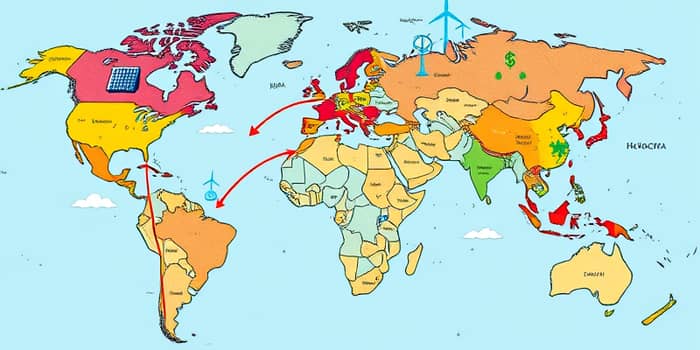
What does energy independence look like on the ground? Strategies vary dramatically by region, fuel mix, and asset class. Below, we explore the defining features and investment angles of key players.
China’s 2024 additions—278 GW of solar and 80 GW of wind—accounted for 69% of G20 solar and 76% of wind expansions. By year-end, China held nearly half of G20 installed renewable capacity. Wood Mackenzie anticipates 380 GW of new wind and solar in 2025—more than three times the US and Europe combined.
With a 55% market share in plug-in vehicles, China is rapidly electrifying transport. State policies explicitly link renewables, storage, batteries, EVs, and nuclear to oil and gas import reduction and technological scale and export dominance.
Investment angles: exposure to leading solar panel and battery manufacturers; global EV supply-chain champions; risks from trade restrictions, overcapacity, and shifting diplomatic winds.
In the aftermath of the Ukraine war, the EU has accelerated its clean-energy rollout. The European Green Deal sets a 2050 climate-neutral target, driving large-scale investment in offshore wind, solar, interconnections, and energy efficiency.
Europe is also onshoring clean-tech manufacturing—PV, batteries, electrolyzers—to reduce reliance on external suppliers. However, permitting hurdles and grid integration challenges persist.
Investment angles: offshore wind platforms, regulated grid assets, green bonds; watch policy alignment and permitting timelines.
The Inflation Reduction Act unleashed a wave of incentives, but recent rollbacks highlight policy volatility as investment risk. In early 2025, global renewables funding peaked, yet US renewable investment slipped from $57 billion (H2 2024) to under $40 billion (H1 2025).
Still, renewables dominated US capacity additions: 93% of new power capacity through September 2025, with solar+storage claiming 83%. Utility-scale wind and solar projects accounted for 71% of the 48.4 GW commissioned in 2024.
New demand drivers—onshoring of manufacturing, electrification, and swelling data-center loads—are reshaping power‐purchase structures and grid needs.
Investment angles: solar+storage developers, transmission infrastructure, data-center power partnerships; monitor tax credits, foreign‐entity restrictions, and interconnection queues.
India has already surpassed its 2030 target of 40% non-fossil power capacity nine years ahead of schedule. Central and state incentives bolster domestic manufacturing of solar modules, batteries, and hydrogen equipment, while mandates ensure rapid deployment.
With 5% energy demand growth in 2024, India is emerging as a hub for energy storage, clean hydrogen, and solar exports. Yet grid stability and execution speed remain critical hurdles.
Investment angles: independent power producers in renewables, solar manufacturing enterprises, battery and EV ecosystem players; assess regulatory clarity and local execution risk.
Non-OECD economies—from Indonesia to Vietnam—still expand coal and gas to meet surging demand, even as they add renewables. Hydrocarbon exporters, notably in the Middle East, deploy sovereign wealth toward both solar build-out and natural gas pipelines to secure domestic power.
These markets present a delicate balance between balancing growth with environmental goals and ensuring stable supply. Currency volatility, policy shifts, and infrastructure gaps amplify execution risks.
Investment angles: diversified portfolios blending renewables with domestic gas assets; selective exposure to sovereign-backed projects with favorable off-take arrangements.
Ultimately, the pursuit of energy independence is a capital-intensive journey shaped by geopolitics, decarbonization, and strategic capital allocation. Investors must navigate regional nuances, policy fluctuations, and the evolving energy mix, all while investing with both purpose and prudence to capture the transition’s greatest opportunities.
References