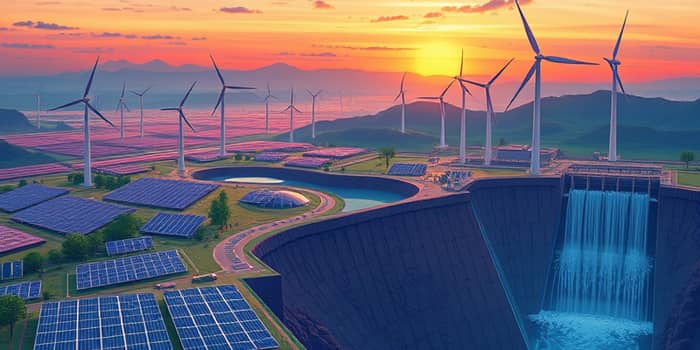
In recent years, the world has witnessed an unprecedented acceleration in the deployment of clean power. In 2024 alone, a record-breaking 741 GW added of renewable capacity marked a decisive shift. Solar contributed 602 GW, while wind added 117 GW, together accounting for 92.5% of new generation capacity. As of mid-2025, renewables supplied 34.3% of global electricity and met 100% of demand growth in the first three quarters. By 2026, forecasts suggest renewables will overtake coal with a 36% share of power generation.
The pace of capacity additions in 2024 shattered previous records, driven by plummeting module costs and supportive policies in many regions. Solar has become the default option for new projects, outcompeting gas even without subsidies in key markets. Meanwhile, total wind capacity now exceeds 1,100 GW, and combined wind and solar generation is on track to surpass 6,000 TWh by 2026, up from roughly 4,900 TWh in 2024.
Investment into clean energy also reached new heights, with USD 386 billion poured into renewable technologies in the first half of 2025 alone. At the current trajectory, global investment could top USD 2.2 trillion for clean tech in 2025, representing a global renewable investment surge unmatched by any previous energy transition.
China has cemented its leadership by adding 434 GW in 2025, contributing 60% of all new global capacity and holding a total of 1,400 GW—half of the world's total capacity. This scale has provided both market certainty and cost advantages. In the United States, hyperscale data centers secured carbon-free contracts and spurred growth in battery storage and baseload renewables. The European Union continued to retire coal plants, driving wind and solar to record shares in electricity mixes.
With investment into clean technologies soaring, developers and utilities are accelerating project pipelines. Tax credits and lower financing costs have encouraged developers to utilize safe-harbor provisions ahead of policy sunsets in 2026. Innovations in storage, AI-driven grid management, and liquid cooling for data centers promise to enhance flexibility and reliability.
Electrification of transport, heating, and industry stands to benefit from these advances. Regions like Denmark already source 70% of their power from wind and solar, showcasing what is possible when policies align with market forces. Meanwhile, emerging economies in the Global South are leapfrogging fossil fuels, adopting renewables to drive development and energy access.
Despite the momentum, several headwinds threaten to slow progress. In the United States, phaseouts of key credits under the 2025 legislative shifts have raised costs by up to 55% for solar and 63% for wind. Antidumping duties and Section 232 trade actions on modules, turbines, and critical minerals have injected uncertainty into supply chains.
At the same time, rapidly growing interconnection queues and public concerns over land use and battery safety are delaying project awards. Geopolitical tensions have also prompted tariffs as high as 3,404% on imports from certain countries, underscoring the complexity of balancing energy security with global collaboration.
As renewables become the dominant power source, energy policy has emerged as a tool of statecraft. China’s manufacturing scale has raised concerns over dependency, prompting Western nations to diversify supply chains. Meanwhile, populist backlashes in some democracies threaten to roll back renewable mandates, even as electrification demands accelerate.
Collaboration on research, standards, and cross-border interconnections will be essential to mitigate risk. At the same time, strategic investments in domestic manufacturing, workforce development, and resilient grids can safeguard progress against sudden policy reversals.
IEA projections indicate renewables will reach 4,600 GW of new capacity by 2030, with solar accounting for 80% of growth. To achieve this trajectory, policymakers and industry must address integration bottlenecks, streamline permitting, and sustain favorable market frameworks.
Accelerating electrification, enhancing flexibility through storage, and fostering innovation in emerging technologies like green hydrogen will expand the toolkit. With rapid cost declines drive adoption, the march toward net-zero emissions can gain both speed and scale.
Real-world examples highlight the potential of ambitious, integrated approaches:
The global race for renewable energy is far from a simple contest of capacity counts. It is a complex weave of technology, policy, geopolitics, and finance. By learning from leaders, addressing systemic challenges, and fostering broad collaboration, we can ensure a resilient and equitable energy future. The road ahead demands vision and resolve, but the destination—a world powered predominantly by clean, affordable, and abundant energy—is within reach.
References