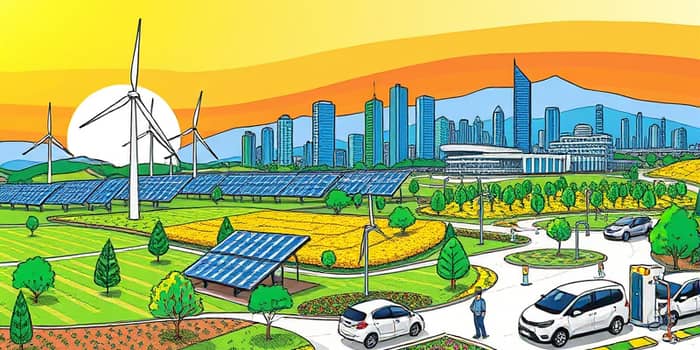
The term Green Transition represents a profound reimagining of how societies produce, consume, and regenerate. It demands a move away from the traditional carbon-based, linear economy toward systems built on circular economy principles for sustainability. This journey encompasses decarbonization, renewable energy deployment, resource efficiency, sustainable land use, and inclusive social policies. Far from being a niche concern, it addresses pressing challenges such as climate change, biodiversity loss, and resource depletion while unlocking new economic opportunities and fostering resilient communities.
As we enter 2026, the scale and speed of investment in clean technologies and sustainable infrastructure have reached unprecedented heights. This article explores the record-breaking capital flows in 2025, the forces driving this momentum, the obstacles that remain, and how individuals, businesses, and governments can align to ensure the transition delivers both environmental protection and broad-based prosperity.
In 2025, global investment in energy transition soared past $3.3 trillion, with roughly $2.2 trillion—two-thirds of total spending—dedicated to clean energy solutions. From solar and wind power to advanced battery storage and grid modernization, this influx of funding signals a decisive shift. Renewables alone captured $386 billion in the first half of the year, driving overall energy transition investment to $2.3 trillion—an 8% increase over 2024.
Meanwhile, capital earmarked for AI-related infrastructure climbed to $1.5 trillion, projected to reach $2.0 trillion in 2026. As data centers expand, accounting for 4.4% of U.S. electricity in 2025 and expected to double by 2028, their energy demand underscores the imperative for clean baseload sources and efficiency measures.
This surge reflects a global consensus: renewable sources are now the primary engines of electricity growth, outpacing coal and gas. Policy incentives, technological maturity, and falling costs converge to make green assets increasingly attractive to investors and innovators.
Multiple interlinked factors propel the Green Transition forward. The scientific community’s warnings about climate risks have galvanized public opinion and spurred regulatory action. Simultaneously, limited natural resources and volatile fossil fuel markets highlight the economic unsustainability of status quo energy models. As a result, nations, corporations, and communities are seeking stability through diversified, low-carbon energy portfolios.
Despite remarkable gains, the transition faces significant hurdles. Aging grid infrastructure, policy uncertainty, and local permitting delays can stall project development. In some regions, rollback of renewable portfolio standards or shifts in political priorities introduce volatility. Moreover, the rapid growth of data centers and AI applications creates new stress on electricity systems, demanding sophisticated integration strategies.
The vast scale of investment points to transformative potential. By 2030, grid and storage spending may approach $900 billion annually, enabling higher shares of variable renewables. Nuclear power, once sidelined, is experiencing renewed interest as a stable, low-carbon complement to wind and solar, especially for high-demand facilities such as data centers.
Emerging strategies in sustainable finance—such as green bonds, blended public-private funds, and biodiversity credits—offer pathways to channel capital into underfunded areas like sustainable agriculture and circular materials. Meanwhile, hybrid power purchase agreements are unlocking new project structures that share risk and reward among developers, investors, and offtakers.
Achieving a successful transition requires collective action across all sectors. Businesses can set science-based targets, shift procurement to renewable sources, and invest in energy efficiency. Local governments and communities should accelerate permitting for clean energy projects, support workforce retraining in green industries, and incentivize sustainable building practices.
On a personal level, individuals can reduce their carbon footprints through energy-efficient appliances, rooftop solar, electric vehicles, and circular consumption—repairing and recycling rather than discarding. Advocacy and voting for climate-friendly policies remain critical. By aligning purchasing power and civic engagement with sustainability goals, every person can become a catalyst for change.
The Green Transition is more than a collection of isolated initiatives—it is a systemic change across global industries that promises to reshape economies, ecosystems, and societies. The record levels of investment in 2025 and the robust projections for 2026 underscore both the urgency and opportunity of this moment. By confronting challenges head-on and embracing innovative financial, technological, and social solutions, we can build a resilient, inclusive, and sustainable future. The time to invest, act, and inspire is now.
References