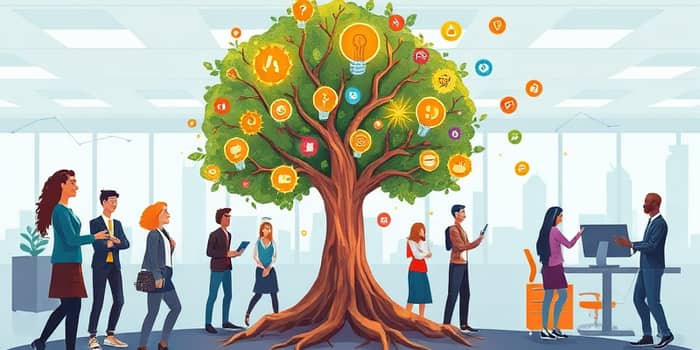
In today's rapidly evolving business world, success hinges on more than just technology or market trends. Strategic talent management emerges as a critical driver of innovation and growth.
By placing people at the heart of organizational strategy, companies can navigate uncertainty with confidence. Build a high-performance workforce that thrives on purpose and agility.
This article explores how focusing on the human factor revolutionizes talent practices. We provide practical insights to inspire and guide you toward a brighter future.
At its core, strategic talent management involves proactive alignment of human capital with business goals. Align talent acquisition, development, and retention to create a resilient organization.
It moves beyond traditional HR functions to foster continuous learning and development. Foster leadership pipelines that ensure stability and innovation.
With challenges like high turnover—55% of U.S. employees considered quitting in 2022—this approach is essential. Millennials and Gen Z prioritize fairness and purpose, making it non-negotiable.
Effective strategies yield substantial rewards, supported by robust data and real-world examples. Skill readiness and reduced learning curves empower employees for faster promotions.
Cost savings are significant through minimized recruitment and turnover expenses. Cost savings on recruitment highlights internal upskilling as a smart investment.
Employee engagement surges when growth opportunities align with personal aspirations. Employee engagement and retention boost morale and loyalty across teams.
Organizational agility enhances the ability to adapt to market shifts swiftly. Organizational agility and performance drive sustained competitive advantages.
Innovation flourishes as diverse talent pools bring fresh perspectives. Innovation and competitive edge position companies for long-term dominance.
To stay ahead, organizations must adopt interconnected pillars that form a cohesive system. Create a self-reinforcing ecosystem where each practice supports the others.
Strategic workforce planning starts by aligning talent with long-term objectives. Start with high-impact roles like engineering to maximize initial benefits.
Competency-based management defines key skills for roles and organizational culture. Define core competencies such as adaptability to guide hiring and development.
Continuous performance management shifts from annual reviews to real-time feedback. Shift to ongoing check-ins that foster growth and accountability.
Data-driven talent analytics leverages metrics for informed decision-making. Leverage metrics for decisions to predict trends and measure ROI.
Successful implementation requires careful planning and a focus on people. Start with strategic alignment by involving leadership from the outset.
Identify business priorities and map them to talent needs for clarity. Map them to talent needs to ensure resources are allocated effectively.
Review the employee lifecycle to integrate practices seamlessly across stages. Integrate practices seamlessly from recruitment to retirement.
Use data to refine strategies and set quantifiable objectives for tracking progress. Set quantifiable objectives like retention rates or pipeline strength.
Promote cultural shifts towards empathy, diversity, and continuous improvement. Promote cultural shifts that value each individual's contribution.
This table outlines key practices and their implementation details:
Effective talent management relies on robust tools that provide comprehensive insights. Cover the employee lifecycle with 360-degree views for better decision-making.
Use technology for skills mapping and gap identification to target development. Skills mapping and gap identification ensure training is relevant and impactful.
Implement frameworks that connect practices to business priorities for cohesion. Connect practices to business priorities to maximize alignment and results.
Define quantifiable objectives to measure success and guide continuous improvement. Measure success and guide improvement through clear metrics and feedback loops.
Foster inclusive cultures that promote creativity and high performance across teams. Promote creativity and high performance by valuing diverse perspectives.
The talent landscape is evolving, with new trends shaping the future of work. Prepare for skills hysteria as organizations scramble to address emerging needs.
Agentic AI will enhance efficiency by automating routine tasks and personalizing experiences. Enhance efficiency by automating to free up human creativity.
Focus on high performers and clarified employment deals to retain top talent. Retain top talent through transparent and rewarding engagements.
Emphasis on purpose and fairness will cater to younger demographics' values. Cater to younger demographics by aligning work with meaningful impact.
Skills-based everything will become the norm, shifting hiring and development paradigms. Shift hiring and development paradigms to prioritize capabilities.
Ultimately, talent management is about valuing and nurturing people. Value, challenge, and motivate growth in every employee to unlock potential.
Adopt empathy-led management that builds strong relationships and trust. Build strong relationships and trust through consistent support and understanding.
Promote diversity and team complementarity to drive innovation and resilience. Drive innovation and resilience by embracing varied backgrounds and ideas.
Involve leadership in aligning succession with organizational goals for continuity. Align succession with organizational goals to prepare for uncertainties.
Address challenges like burnout and skill shortages with proactive, people-first solutions. Address challenges proactively to maintain a healthy and productive workforce.
By centering strategies on the human factor, organizations can achieve unparalleled success. Drive long-term growth and resilience through empowered and engaged talent, ensuring a legacy of innovation and impact.
References