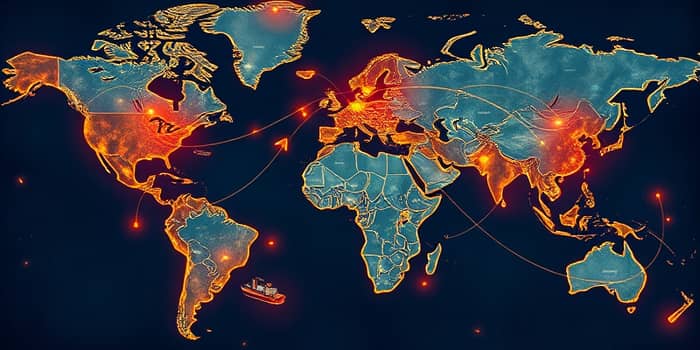
In an era of shifting power balances and evolving economic ties, the concentration of trade flows in few blocs has become a defining feature of global commerce. Nearly 60% of merchandise trade circulates through six dominant alliances, reflecting how deeply intertwined our economies have grown. Yet, beneath this apparent unity lies a pattern of geopolitical fragmentation into competing nodes that reshape supply chains, influence policy, and test the resilience of nations.
The world’s merchandise trade is overwhelmingly funneled through a handful of major groupings. These blocs not only drive exports and imports but also anchor regional supply chains and investment flows. Understanding their profiles offers a window into global economic health and future trends.
The EU remains the most integrated system, balancing production and consumption even as external trade slows under rising energy costs. Meanwhile, USMCA leverages nearshoring and China plus one strategies to shorten supply chains and secure critical inputs close to home. ASEAN continues its rise as a production powerhouse, with Vietnam emerging as a pivotal re-export hub.
Beyond the six major blocs, new formations and plurilateral arrangements are gaining traction. These networks reflect shared norms, strategic diversification, and a desire to reduce overreliance on any single economic giant.
Intra-group trade among Plurilateralists is projected to grow at a 3% CAGR through 2034, underscoring how shared rules and diversification to swing state partners drive new economic corridors. BRICS+ also looks to deepen ties with the Global South, targeting a 3% annual expansion in goods exchange.
Several powerful trends are reshaping how goods, services, and capital move across borders. These dynamics highlight both opportunities and risks as nations balance efficiency with security.
Post-pandemic portfolios now emphasize regionalized supply chains reshaping global trade and resilience. The US leverages tariffs as strategic levers, while the EU’s Critical Raw Materials Act and “Made in Europe” campaign drive near-neighbor sourcing.
Global merchandise trade grew by 4.2% in 2025, but volatility looms as US-EU tensions and US-China tariff truce deadlines approach in late 2026. Despite this, merchandise flows are expected to expand at roughly 2.5% annually, outpacing global GDP growth.
China achieved a record $1.2 trillion trade surplus in 2025, outpacing US goods growth by over 40%. Its trade with BRICS+ is set to rise at 5.5% CAGR, while ties with the broader Global South climb at 3% annually. Intra-Asia trade continues to outstrip world averages, driven by RCEP members and bilateral agreements that foster deep interdependence.
Despite robust blocs, significant gaps remain. African groupings such as SADC and ECOWAS each account for less than 2% of global trade, hindered by infrastructure deficits and policy fragmentation. South Asia’s SAFTA sees low intra-regional exchange, overshadowed by India’s dominant import needs.
Yet, these challenges also present openings. Nearshoring offers new investment in Mexico, Eastern Europe, North Africa, and India. The rise of Plurilateralist standards opens markets with aligned regulations, and sustainability mandates foster green supply chains that can unite diverse partners around common goals.
The intertwined nature of major trade blocs underscores a paradox: deep interdependence coexists with mounting fragmentation. By embracing strategic diversification, investing in resilient supply chains, and championing sustainable practices, nations can navigate geopolitical headwinds and foster inclusive prosperity.
Ultimately, the future of global commerce depends on our ability to balance competitive interests with collective action—ensuring that the engines of trade continue to drive growth, innovation, and shared well-being across every continent.
References