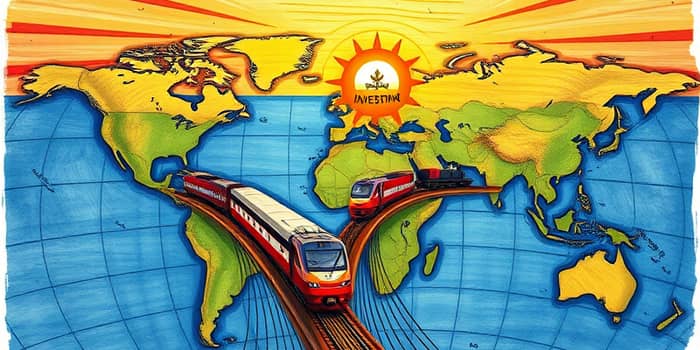
The Belt and Road Initiative (BRI), often called the New Silk Roads, is reshaping global trade and opening unprecedented investment avenues. Launched in 2013 by President Xi Jinping, this ambitious vision revives ancient trade routes while forging win-win cooperation across nations. Today, over 160 countries participate, representing nearly three quarters of the world’s population and more than half of global GDP. As investors, entrepreneurs, and policymakers seek purpose and profit, the New Silk Roads offer a roadmap to sustainable growth and shared prosperity.
For millennia, the Silk Roads connected East and West through caravans, ports, and cultural exchange. The BRI honors that legacy by stitching together railways, highways, ports, and digital networks. What began as a vision in a 2013 speech at Nazarbayev University now spans six land corridors and major maritime channels. Beyond concrete and steel, it embodies a philosophy of building a global community of shared future, where infrastructure drives human bonds, and economic corridors become arteries of cultural understanding.
At its core, the initiative seeks not only to trade goods but to transmit ideas, technologies, and sustainable practices. From renewable energy projects in Pakistan to high-speed rail links between China and Europe, each corridor reinforces connectivity while promoting low-carbon transport solutions and digital integration. By bridging distant markets, the BRI fosters a spirit of collective ambition and mutual respect.
BRI investments focus on strategic infrastructure corridors for trade, spanning continents and oceans. These spine routes streamline logistics, reduce transit times, and lower costs. Simultaneously, digital highways, such as the Digital Silk Road, enable data centers, 5G networks, and e-commerce platforms to flourish across partner nations.
Maritime routes complement land links by connecting Chinese ports to Southeast Asia, the Arabian Peninsula, East Africa, and Europe. A network of refueling stations and upgraded harbors bypasses strategic chokepoints, ensuring uninterrupted flows of goods and resources.
The year 2025 marked a milestone for the BRI: record-breaking USD 128.4 billion in construction contracts, a 62% jump in non-financial investments reaching USD 85.2 billion, and total engagement of USD 213.5 billion across more than 350 deals. Energy led the surge with USD 93.9 billion—more than double the previous record—driven by renewables, pipelines, and mining projects. Technology and manufacturing posted USD 28.7 billion, highlighting data centers, electric vehicle battery plants, and hydrogen facilities in emerging markets like Nigeria.
Notable achievements include flagship rail tunnels under the Alps, expanded port terminals in Gwadar, advanced semiconductor fabs in Southeast Asia, and greenfield renewable plants across Central Asia. As a pipeline of over USD 300 billion in next-generation data and manufacturing ventures emerges, 2026 promises further momentum.
Investors seeking tangible entry points can focus on sectors where BRI dynamics yield outsized returns:
By aligning with local development goals—such as poverty reduction, employment creation, and resource efficiency—investors amplify impact. Public-private partnerships, green finance instruments, and multi-lateral funding platforms like the Asian Infrastructure Investment Bank offer frameworks to mitigate risk and catalyze co-investment.
No great venture is without challenges. Critics warn of debt sustainability, governance gaps, and geopolitical sensitivities. High-yield debt issuance in some host countries can strain budgets, while uneven procurement rules may favor Chinese firms over local contractors. To succeed, investors must prioritize transparency, community engagement, and capacity building.
By embracing supply chain resilience amid volatility and leveraging local expertise, stakeholders can balance risk and reward. Thorough due diligence, diversified portfolios, and climate-aligned strategies help ensure that each project not only generates returns but also uplifts communities and safeguards the environment.
The following table highlights key opportunities and challenges facing the BRI today:
As the New Silk Roads weave ever more tightly, we stand at the threshold of a truly interconnected planet. By championing win-win cooperation across nations and embracing lowest transport costs and carbon emissions, stakeholders—from policymakers to entrepreneurs—can build resilient, inclusive value chains. The story of the BRI is still unfolding, offering opportunities to pioneer sustainable technologies, forge enduring partnerships, and catalyze human progress.
Let us envision a world where trains glide silently across mountains, cargo vessels chart safe passages beyond strategic chokepoints, and digital highways transmit knowledge at the speed of light. In that world, investment is not merely a financial act but a gesture of solidarity, weaving dreams into reality and crafting a legacy of shared prosperity for generations to come.
References