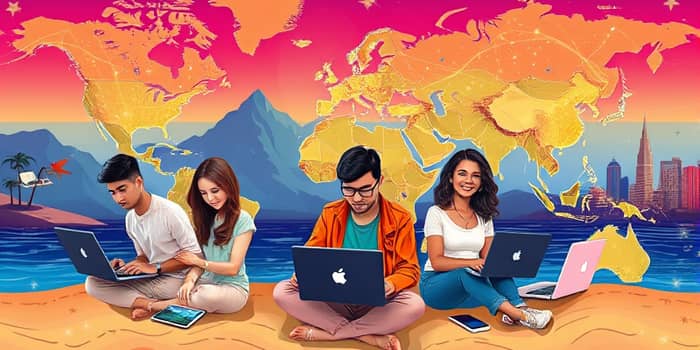
The phenomenon of digital nomadism has transformed the way millions live and work, blending professional ambition with global exploration. As remote work becomes mainstream, individuals are no longer tethered to a single office or city. Instead, they span continents while maintaining productive careers.
This article delves into the four pillars of this movement: scale and profile, drivers behind its rise, economic impacts on home and host countries, and the most compelling investment opportunities emerging from this trend. By understanding these dimensions, entrepreneurs, policymakers, and investors can harness the potential of a truly borderless workforce.
Digital nomads are defined as individuals who perform knowledge work remotely while traveling and living in multiple locations. Enabled by a suite of cloud tools, co-working spaces, and innovative visa programs, they represent a vibrant subset of the global remote workforce.
The U.S. segment has grown explosively since 2019, from around 7.5 million nomads to an expected 18.5 million in 2025—a 153% increase. This cohort comprises both employees of established companies and independent freelancers. In 2025, 11.2 million U.S. nomads hold traditional jobs, while 7.3 million operate as freelancers, contractors, or solopreneurs.
Demographically, the average nomad is 36 years old, with Millennials and Gen Z making up nearly 65% of the community. About 90% hold college degrees, and almost all rely heavily on technology, with 89% using AI in their workflows. Annual incomes average around $124,000 globally, granting nomads powerful spending capacity in host countries.
Several forces converge to fuel the digital nomad movement, reshaping workplace norms and individual lifestyles around the globe.
Beyond infrastructure, economic motivations play a critical role. Nomads exploit arbitrage between high incomes and local living, retaining salaries from major economies while residing in affordable countries. This approach helps reduce debt, boost savings, and foster financial resilience.
Moreover, lifestyle preferences drive many to seek flexibility, autonomy, and cultural enrichment over rigid office routines. Strong online communities, co-living spaces, and wellness-focused hobbies reinforce the appeal of a location-independent existence.
Digital nomadism generates significant economic ripple effects, both where nomads originate and where they settle temporarily.
In origin countries like the U.S., the rise of remote work reduces urban congestion and can redistribute economic activity as workers migrate away from high-cost cities. However, it may also challenge local commercial real estate, prompting landlords to adapt properties for shared offices and hybrid workspace models.
Host countries receive immediate benefits through increased consumer spending on accommodation, dining, recreation, and transport. High-earning nomads typically spend above local averages, stimulating small businesses and service sectors. Seasonal and medium-term arrivals can smooth tourism fluctuations, offering year-round revenue streams.
Governments are responding with policy measures: visa programs often require proof of income above set thresholds and minimal local labor competition. By targeting affluent, low-dependency residents, host nations aim to capture spending without straining public services.
The digital nomad trend unlocks diverse investment avenues, from infrastructure development to specialized services. Savvy investors can capitalize on evolving demands across real estate, tourism, technology, and policy-driven niches.
For real estate, look at emerging hubs in Southeast Asia, Eastern Europe, and Latin America, where property prices remain relatively low and digital infrastructure is improving. In tourism, focus on wellness-oriented offerings and adventure travel segments favored by nomads.
Tech entrepreneurs can leverage the high rate of AI adoption among nomads by creating niche platforms for networking, project management, and secure global payments. Meanwhile, visa facilitation startups can partner with governments to optimize application processes, offering seamless digital experiences.
Ultimately, digital nomadism represents a powerful intersection of work, travel, and investment. By understanding its scale, drivers, and impacts, stakeholders can craft strategies that benefit global economies, empower mobile professionals, and generate sustainable returns.
References