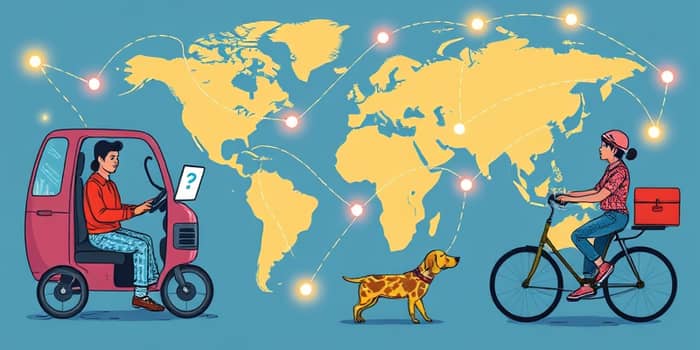
The global gig economy is no longer a fringe phenomenon—it has become a driving force reshaping labor markets, corporate strategies, and investment portfolios. From ridesharing to freelance coding, independent work has surged into mainstream economic activity.
Over the past decade, the gig economy has demonstrated extraordinary growth and resilience. Platform-driven marketplaces are collectively valued between $455–646 billion, with annual expansion rates of 16–17%. In revenue terms, freelance and gig work contribute an estimated $3–3.8 trillion to global GDP.
In the United States alone, freelancers earned $1.27 trillion in 2023, and projections anticipate the U.S. gig economy to exceed $556 billion by 2024, potentially tripling by 2032. These figures underscore an era where flexible, task-based work is central to economic output.
Today’s labor markets are witnessing a profound shift. Approximately 12% of the global workforce engages in gig work, and this proportion is set to reach 35% in the coming years. In the U.S., 38% of workers—over 64 million people—participated in freelance activities in 2023.
Full-time independents in America have more than doubled since 2020, rising from 13.6 million to 27.7 million (16.7%). Experts forecast 86.5 million U.S. freelancers by 2027 and over 90 million by 2028, surpassing half of the total workforce.
High-earning independents also rose from 3 million to 4.7 million earning over $100,000 annually, highlighting the potential for career stability within flexible roles.
The gig economy’s expansion is not uniform. In the U.S., Florida leads with 22% of full-time independents, followed by California (20%), Texas, and Illinois (18%). Globally, India, Brazil, Indonesia, and even Sub-Saharan Africa are emerging as dynamic markets.
Sectors vary by region: technology, business services, and marketing dominate U.S. freelancing, while transportation services maintain a strong global presence. Seasonal surges of about 20% in short-term gigs occur during summer months, reflecting consumer demand fluctuations.
Platform stocks have become hot investment targets as they offer exposure to flexible labor markets. Companies like Airbnb, Uber, DoorDash, Fiverr, and Lyft provide diverse avenues for investors seeking growth aligned with gig trends.
Below is a summary of the top publicly traded gig economy companies:
Investors can also explore high-potential startups that address gig workers’ unique needs. Companies like Catch and Zego focus on benefits and insurance, while Instawork, Rover, and VoPay tackle job matching, pet services, and fintech solutions respectively.
Despite rapid growth, the gig economy faces challenges. Workers often lack traditional benefits, prompting a wave of startups to offer insurance, retirement plans, and tax tools. Policy makers are advocating for income security and portable benefits to sustain this workforce.
Optimism remains strong: 86% of freelancers believe their best days lie ahead, fueled by remote work trends and companies’ need for scalable, global talent pools.
Looking forward, the gig economy is projected to encompass over 90 million U.S. workers by 2028 and continue its upward trajectory worldwide. For investors and participants alike, understanding the evolving platforms, regulatory landscape, and regional dynamics will be crucial to unlocking the full potential of this transformative labor model.
References