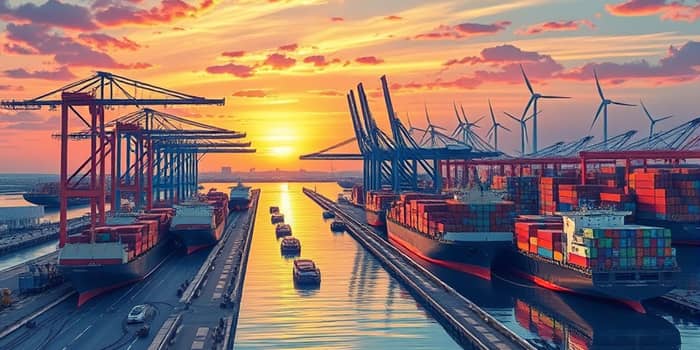
Ports are the lifeblood of the global economy, weaving together commerce, technology, and sustainability. Their growth mirrors the dynamism of international trade and underpins the resilience of supply chains worldwide.
In this article, we explore how strategic investments and emerging trends are transforming port infrastructure into hubs of innovation and environmental stewardship.
The global port infrastructure market reached US$163.4 billion in 2024, driven by rapid industrialization and increased maritime trade. Forecasts predict a rise to US$207.9 billion by 2030 at a 4.1% compound annual growth rate, reflecting steady demand for expanded capacity and modernization.
Alternative analyses suggest growth from US$166.32 billion today to US$276.12 billion by 2034 at 5.20% CAGR. The Asia-Pacific region leads with a valuation of US$78.17 billion in 2024, projected to surge to US$131.16 billion by 2034 at a 5.30% CAGR. Global investments in port assets topped US$73 billion in 2024 and are expected to exceed US$132.6 billion by 2030, underlining strong confidence in maritime infrastructure.
Over over 80% of international trade by volume moves via sea, making port efficiency indispensable for economic competitiveness. In the United States alone, ports contribute US$2.59 trillion to GDP and support one in eight American jobs, showcasing their critical role in national prosperity.
Shanghai remains the world’s busiest container port, handling 51.5 million TEUs (world's busiest) in 2024. Singapore excels in connectivity and automation, while Ningbo-Zhoushan achieved a 26% volume increase over three years, driven by its Belt and Road Initiative role.
These ports set benchmarks in sustainability, deploying shore power systems and green corridors to reduce emissions. Their continuous innovation underlines the shift toward more resilient and eco-friendly operations.
The Northwest Seaport Alliance fuels 58,000 jobs and US$12.4 billion in economic activity, sustaining 13 consecutive months of import growth through March 2025. In the UK, container tonnage jumped 13% to 18.2 million tonnes in Q1 2025. U.S. industrial markets near ports absorbed 21% of national demand between 2019 and 2024, with double-digit rent growth forecast in key regions.
Despite expansion, port efficiency dipped in Q2 2025. Metrics such as port-moves-per-hour and berth hours worsened globally, partly due to the Red Sea crisis. In North America, average turnaround times increased by 0.14 days in July 2025. S&P predicts U.S. container volumes may decline by 4% in 2025 and 2% in 2026 amid trade tensions.
Port authorities and operators are responding with targeted investments. Projects include deepwater berths and automated terminals, crane upgrades for mega-vessels, and extensive dredging to accommodate larger ships. Federal grants, terminal sales, and tenant contributions fund these initiatives, while digital tools and advanced analytics enhance operational visibility.
E-commerce growth is fueling demand for ports with strong multimodal links, while technology adoption accelerates through IoT sensors and AI-driven scheduling. Sustainability remains paramount: less than 14% of new vessel tonnage is alternative fuel-ready, but ports are pioneering green hydrogen projects and shore power systems.
Ports are evolving into integrated logistics nodes, connecting warehousing, rail, and road networks for seamless cargo movement. Adopting scalable infrastructure, strong customer relationships, and robust contingency plans will further strengthen supply chain resilience.
As global trade corridors expand and nearshoring gains traction, ports that embrace innovation and sustainability will secure their position as critical economic gateways. By fostering collaboration among stakeholders and investing in the latest technologies, the maritime industry can navigate future challenges and continue to drive prosperity worldwide.
References