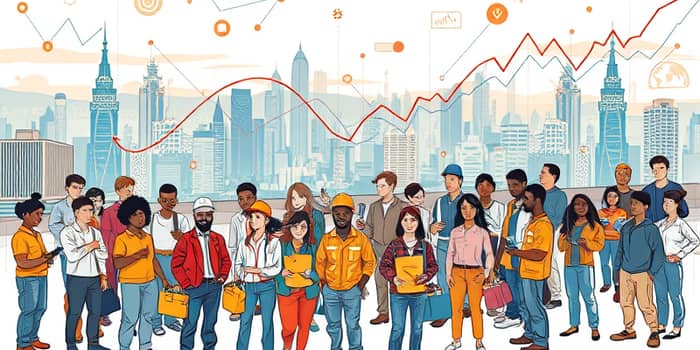
The global labor market is undergoing profound shifts that ripple through every corner of the economy. From headline unemployment figures to the rise of gig platforms and the threat of AI disruption, these changes directly influence how investors assess risk and allocate capital. Understanding these forces is essential for anyone seeking to navigate a world where labor and capital are more interconnected than ever.
Although the global unemployment rate has hovered around 4.9% since 2023, this apparent stability masks deeper structural challenges. Beneath the surface, tens of millions of aspiring workers remain on the margins, unable to secure sustainable livelihoods. As labor dynamics evolve, so too must investment strategies, lest portfolios become exposed to unforeseen shocks.
One of the most pressing issues today is the widening disconnect between unemployment statistics and actual employment accessibility. Official data show a stable jobless rate, but the global jobs gap reaches 408 million people unable to find paid work. This gap highlights the urgent need for more inclusive growth and targeted policies that expand opportunities in both developed and emerging economies.
The quality of work is another critical concern. Despite economic progress, nearly 300 million workers still live in extreme poverty, and over 2.1 billion people remain in informal employment without basic social protections. As inflationary pressures erode real wages, the ability of workers to enhance living standards has stalled, limiting consumer demand and weighing on overall economic resilience.
The youth employment crisis compounds these challenges. With one in eight young people unemployed and one in five not in education or training, the risk of long-term scarring is high. As AI adoption accelerates, entry-level roles may shrink, making it harder for new graduates to gain the experience they need.
Global supply chains still support roughly 465 million jobs linked to foreign demand, often providing better wages and working conditions in developing countries. However, slower trade growth and geopolitical uncertainty threaten to curb this source of job creation, signaling a need for diversification in export markets and supply chain strategies.
Technological disruption, particularly through AI, presents a double-edged sword. On one hand, automation can boost productivity and unlock new services. On the other, AI layoffs outpacing productivity gains are already evident in some industries, as firms delay hiring while reassessing workforce needs and skill requirements. Investors must weigh the pace of AI integration against potential displacement risks when evaluating company valuations.
The gig economy continues its rapid expansion, projected to grow from $674.13 billion in 2026 to $2,522.37 billion by 2035. Driven by a desire for autonomy and flexibility, professionals are flocking to freelance platforms despite the absence of traditional benefits. This trend underscores the importance of adaptable business models and flexible labor contracts.
Labor market metrics have proven to be as significant for firm risk as classic investment measures. Research shows that a 10 percentage point increase in a company’s hiring rate correlates with a 1.5 percentage point decrease in its annual risk premium. This hiring return spread—averaging 10.4% per year—remains robust across firm sizes, highlighting how workforce expansion can signal stability and growth potential.
Conversely, a 10 percentage point rise in investment rate often precedes a 1.6–2.3 percentage point drop in future stock returns. Firms that over-invest relative to their capacity to integrate new assets can face diminishing returns. Recognizing these dynamics helps investors balance portfolios between growth-oriented and capital-efficient companies.
Rising market concentration also poses risks. Higher concentration often means fewer employers vying for talent, translating into wage suppression. A 10% increase in concentration leads to a 0.3% fall in average wages, affecting consumer spending power and, ultimately, company revenues.
To capitalize on labor-driven opportunities while mitigating risks, investors and corporate leaders should embrace continuous adaptation through organizational choices that align workforce strategies with long-term objectives. This involves understanding regional labor trends, fostering skill development, and ensuring operational flexibility.
On the corporate side, integrating extended workforce models—combining full-time staff with freelance experts—can enhance agility. Investing in upskilling and reskilling programs prepares employees for evolving roles, while transparent communication on salary and career paths builds trust and retention.
By weaving together insights on employment quality, technological change, trade dynamics, and demographic shifts, stakeholders can forge resilient strategies. The interplay between labor and capital is no longer peripheral; it sits at the core of sustainable growth and risk management.
In an era of rapid change, those who understand and act on labor market signals will be best positioned to secure enduring value. With thoughtful analysis and proactive engagement, we can transform challenges into opportunities, crafting a future where both workers and investors thrive.
References