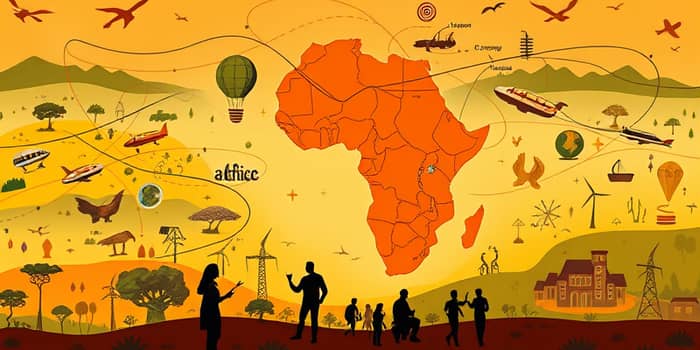
Africa is no longer a blank canvas of untapped promise. Today, it stands at the crossroads of innovation and growth, ready to redefine global investment paradigms. From bustling tech hubs to sun-drenched solar farms, the continent pulses with opportunity.
For decades, Africa was portrayed through a narrow lens of risk and resource extraction. Yet behind this outdated narrative lies a continent with 11 of the world's 15 fastest-growing economies and a GDP of $3.4 trillion driven by consumer and business spending.
By 2030, a growing African middle class will drive a $2.5 trillion consumer market, reshaping demand for goods, services, and experiences. This rise is not hypothetical—it’s happening now, challenging investors to look beyond stereotypes and embrace a dynamic, youthful marketplace.
The investment landscape is shifting from broad, multilateral aid to targeted bilateral investment. China’s longstanding trade relationships are now complemented by a burgeoning Gulf–Africa corridor. In 2023, the UAE pledged $4.5 billion to clean-energy projects alone, signaling a sustained commitment to Africa’s energy transition.
These funds are moving into sectors aligned with global mega-trends—energy, infrastructure, mining, and digital services—fostering deeper partnerships and local capacity building. Investors are increasingly focused on projects that deliver sustainable and resilient operations, ensuring mutual benefit and long-term impact.
Unlocking Africa’s potential requires focus on three high-impact areas:
Each of these sectors lies at the intersection of innovation, strategic need, and market demand, offering compelling entry points for forward-looking investors.
In fintech, mobile-first solutions are leapfrogging traditional banking, with over half of all global mobile-money accounts registered in Africa. Strategic capital from Gulf investors is enhancing predictive analytics, cybersecurity, and local skills development, strengthening financial inclusion for millions.
Meanwhile, the narrative around minerals has evolved from raw extraction to beneficiation. The US Lobito Corridor project and UAE investments in copper-rich nations like Zambia and the DRC illustrate a commitment to on-site processing, creating jobs and generating tax revenue while mitigating commodity price risks.
Lastly, Africa’s energy deficit and climate volatility are converging to demand innovative solutions. Combined solar-storage plants bypass the vulnerabilities of hydropower, offering reliable, off-grid power that underpins healthcare, manufacturing, and communities.
Beyond these three pillars, other industries stand ready to benefit from strategic capital:
Examples abound: youth-led cocoa processing in Côte d’Ivoire, an emerging automotive value chain in Morocco, and digital payment ecosystems in Ethiopia—all proving that Africa is beginning to export value, not just raw commodities.
The African Continental Free Trade Area (AfCFTA) is a game-changer, creating a single market of over 1.5 billion people. By harmonizing regulations and lowering trade barriers, AfCFTA paves the way for cross-border enterprises and regional value chains that drive sustainable job creation.
Africa’s demographic profile strengthens this case: a young, rapidly growing population fueling demand for housing, education, and consumer goods. Urban centers from Nairobi to Lagos are evolving into vibrant innovation hubs, challenging investors to think regionally rather than country-by-country.
Infrastructure deficits and high logistics costs remain real challenges, but they also present opportunities. Investments by DP World and AD Ports Group demonstrate how well-executed transport infrastructure can transform vulnerabilities into strategic assets.
With only three African countries holding investment-grade ratings, risk narratives must evolve. The Africa Business Forum 2026 calls for long-term, risk-tolerant investment, de-risking facilities to channel capital into SMEs and productive sectors, and financing frameworks anchored in value addition and industrial processing.
Key recommendations include:
Inclusive growth demands that women’s economic participation is institutionalized, not treated as an afterthought. By integrating gender lens investing and supporting female entrepreneurs, investors unlock untapped talent and drive social impact.
A vibrant startup ecosystem is already taking shape, fueled by private equity, venture capital, and angel investors. From fintech innovators in Accra to agritech pioneers in Kigali, Africa’s entrepreneurs are building solutions that resonate globally.
Unlocking Africa’s investment potential means moving beyond traditional narratives of risk and extraction. It requires a mindset of partnership—investing in people, ideas, and innovation to power inclusive, job-rich growth.
The data is clear: Africa is ready for a new chapter of strategic investment. By focusing on digital transformation, critical minerals, and energy transition—while supporting agriculture, telecom, and infrastructure—investors can drive lasting impact.
As we look ahead, the greatest returns will come from collaborations that respect local priorities, harness regional integration, and champion inclusive development. Together, we can unlock a future where Africa’s potential is fully realized—beyond tradition, beyond boundaries, and beyond expectation.
References