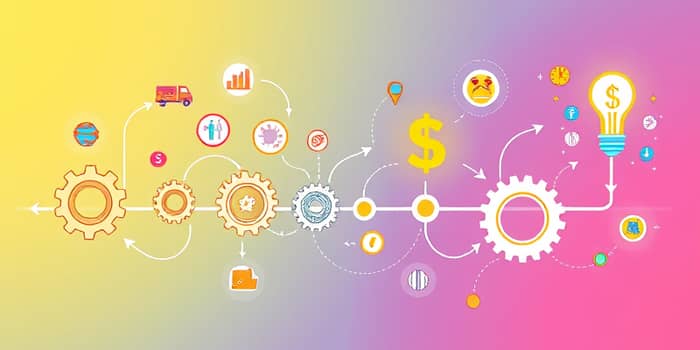
In today's fast-paced business world, staying competitive requires more than just incremental improvements.
Value chain optimization offers a strategic path to excellence by systematically enhancing every activity that contributes to value creation.
This approach focuses on increasing efficiency, resilience, and profit while ensuring customer satisfaction remains high.
It transforms how companies operate from end to end, turning potential weaknesses into strengths.
To understand optimization, start with Michael Porter's value chain model, which divides business functions into primary and support activities.
Primary activities include inbound logistics, operations, outbound logistics, marketing & sales, and service.
Support activities encompass firm infrastructure, human resource management, technology development, and procurement.
Value chain analysis is a method to map, assess, and improve these functions.
It identifies cost drivers and differentiation opportunities to boost competitive advantage.
Optimization takes this further by using advanced analytics and digital tools for strategic adjustments.
It differs from supply chain optimization by including broader aspects like R&D and marketing.
Optimizing the value chain is crucial for achieving sustainable competitive advantage through cost or differentiation strategies.
Cost advantage involves reducing expenses while maintaining quality, such as through economies of scale.
Differentiation advantage increases perceived value to command premium prices, like with superior design.
The business impact is profound, with high-performing chains seeing better revenue growth and stronger margins.
Key benefits include enhanced agility and resilience, which help mitigate disruptions and risks.
Additionally, optimization leads to higher customer satisfaction and supports sustainability goals.
Consider these quantitative effects from industry research.
Effective optimization requires targeting specific areas within the value chain, starting with primary activities.
Each primary activity offers levers for improvement, as summarized in the table below.
Support activities are equally vital and integrate with primary functions to enhance overall performance.
For support activities, focus on these optimization levers.
When integrated well, these activities substantially reduce costs and enhance product quality.
Implementing value chain optimization involves a structured methodology with clear steps.
First, map the value chain by documenting all activities and flows end-to-end.
This includes material, information, and financial streams to create a comprehensive view.
Next, assess each activity for its value contribution versus cost, using tools like activity-based costing.
Identify improvement opportunities by analyzing cost drivers and differentiation factors.
Prioritize actions based on their potential impact on competitive advantage and profit margins.
Then, implement changes with a focus on continuous improvement and leveraging digital tools.
Key digital enablers include advanced analytics, AI, and IoT for real-time insights.
Finally, monitor performance and adjust regularly, ensuring cross-functional alignment and governance.
The core steps in this playbook are straightforward but require diligence.
Value chain optimization is an ongoing journey, not a one-time project.
It demands commitment from all organizational levels and a culture of innovation.
By systematically improving every link in the chain, businesses can unlock unprecedented efficiency and profit.
The rewards include increased profitability, enhanced competitiveness, and sustainable growth.
Start today by assessing your current chain and taking the first step toward optimization.
With the right strategies, you can build a resilient, customer-centric operation that thrives in any market.
References