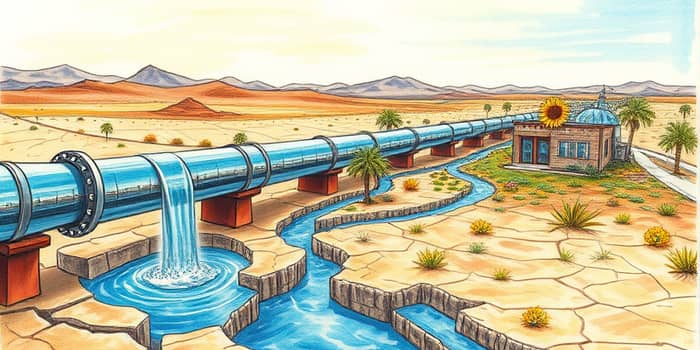
Every drop of water is precious. Today, our world loses 324 billion cubic meters lost annually through mismanagement, waste, and erosion of natural sources. This staggering volume could sustain a metropolis of 280 million people. Meanwhile, nearly two-thirds of global population contend with shortages at least a month each year, and millions face dire risk from groundwater depletion. The crisis is both urgent and universal, demanding a bold vision known as Aqua Solutions.
Falling water tables, shrinking glaciers, and parched aquifers reveal a harsh reality. In the last half-century, global glacier mass declined thirty percent, altering river flows that feed a quarter of humanity. Groundwater supplies half of all domestic usage and forty percent of irrigation water, yet seventy percent of major aquifers are in long-term decline. With climate change intensifying drought patterns and population growth driving up demand, the balance between supply and need has tumbled toward the brink.
Despite technological strides, 2.2 billion people lack safe water and 3.5 billion go without safely managed sanitation. Every year, unsafe water or poor sanitation contributes to 1.6 million child deaths and spreads waterborne diseases affecting over 1.5 billion people. Women and children in rural areas spend hours each day collecting water, perpetuating an unequal burden and limiting opportunities for education or economic growth.
Water scarcity erodes economies as much as it degrades the environment. A one standard deviation increase in scarcity has been linked to GDP growth declines of up to 0.16% and fixed investment drops of nearly 0.42%. At the same time, inflation can surge by up to 3.5% when water becomes scarce, pushing essential goods out of reach for the most vulnerable.
Key economic and social consequences include:
Beyond pure economics, water scarcity disrupts social cohesion. Shared rivers and aquifers can become flashpoints for conflict, threatening food security and geopolitical stability. When water becomes a weapon, communities suffer and nations face humanitarian crises.
Certain regions already face acute shortages. Gulf states like Bahrain, Kuwait, and Qatar rank among the highest in scarcity, where less than 20% of renewable water remains. South Asia, home to over half of those experiencing annual shortages, relies heavily on monsoon-fed rivers and depleting aquifers. In India alone, 18% of the global population vies for just 4% of available freshwater, with new hydro projects threatening up to 60% of key river flows.
Southeastern Brazil and parts of Central America, once abundant, now show emerging signs of stress. Projections to 2080 warn of extreme scarcity sweeping Southern Europe, the western United States, and large swathes of Africa, signaling a global challenge that transcends traditional boundaries.
At its core, water scarcity is driven by both human choices and climate forces. Unsustainable agricultural practices, from flood irrigation to monocultures, account for nearly 70% of water withdrawals worldwide. Urbanization and industrial growth compound the challenge, while poor governance and underpriced water perpetuate waste.
Climate change acts as a force multiplier. With rising temperatures, droughts become more frequent and intense, triggering a 25% increase in global water use since 2000. Without robust management, water resources shrink just as demand multiplies.
The path forward requires an infusion of capital, creativity, and collaboration. Over the next four years, an estimated $1.4 trillion in water infrastructure investment is needed to upgrade aging systems, expand treatment facilities, and harness new supply sources. According to the World Bank, a three-part strategy will be central to success:
The private sector is beginning to see water as both a risk and an opportunity. Companies in water-intensive industries—from textiles to data centers—are adopting circular systems, turning waste streams into new inputs. Impact investors are channeling capital into early-stage startups developing low-energy desalination, atmospheric water capture, and AI-driven leak detection. By integrating water risk into financial analysis, investors can unlock returns while driving sustainable practices.
These pillars support a holistic approach that balances ecological health, economic vitality, and social justice. In agriculture, innovative water-smart agriculture practices—such as precision irrigation and drought-resistant crops—can slash consumption by up to 50%. In urban centers, leak detection technology and green infrastructure reduce losses and recharge aquifers.
Leaders, businesses, and communities can embrace practical steps:
Confronting water scarcity demands more than technology—it calls for a collective shift in perspective. We must view water not only as a resource to exploit but as a finite legacy to steward. Every individual can contribute: by reducing personal footprints, supporting local conservation projects, or advocating for science-driven policies.
Communities can mobilize through grassroots water councils, sharing knowledge and co-developing solutions. Education programs in schools and universities can inspire the next generation of engineers, hydrologists, and policymakers to keep momentum alive. When science, policy, and finance converge, the impossible becomes attainable.
As we approach the 2026 UN Water Conference, the agenda must prioritize both ambition and accountability. By aligning public and private capital, and by elevating the voices of those most affected, we can transform crisis into opportunity.
Our world stands at a critical inflection point. With coordinated investment and bold innovation, we can secure water for billions, nurture ecosystems, and fuel sustainable growth. Together, we hold the power to rewrite the narrative—from water bankruptcy to abundance—and to leave a lasting legacy of hope for generations to come.
References